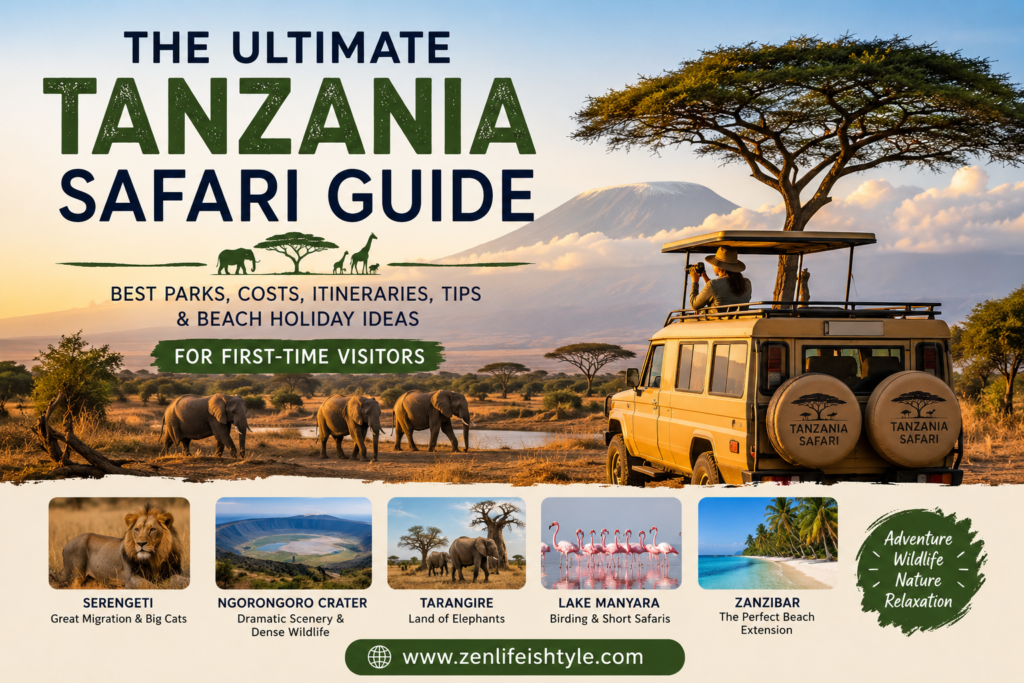
A Tanzania safari is one of the most iconic travel experiences in Africa. If you are dreaming of wide open plains, big wildlife moments, beautiful safari camps, and classic East Africa scenery, Tanzania is one of the best places to start.
For many travellers, the first name that comes to mind is Serengeti National Park. This is one of the most famous safari areas in the world, known for endless plains, big cats, and the Great Migration. Then there is the Ngorongoro Crater, a dramatic natural bowl where wildlife viewing can be excellent in a very compact area.
A safari in Tanzania usually means early morning game drives, expert guides, long days in nature, and peaceful evenings at a safari lodge or one of the many safari camps. Depending on your route, you may see lions, elephants, buffalo, giraffes, zebras, wildebeest, flamingos, and many other wild animals.
Tanzania is also a great choice if you want to combine an African safari with a beach holiday. After days of wildlife viewing in the Serengeti, Ngorongoro, Tarangire or Lake Manyara, many travellers continue to Zanzibar Island for beaches, Stone Town, spice tours, and Indian Ocean relaxation.
This Tanzania safari guide will help you choose where to go, when to visit, what animals you may see, how long to stay, where to stay, and how to plan your safari with confidence.
Why Choose Tanzania for a Safari?
Tanzania is a prime destination for safari because it gives travellers a beautiful mix of wildlife, landscapes, culture, and beach options. If you want a classic African safari in East Africa, Tanzania is one of the strongest choices.
One of the biggest reasons to choose Tanzania is variety. The country has over 22 national parks, which means you can experience very different safari areas in one trip. You can explore the wide Serengeti plains, visit the dramatic Ngorongoro Crater, see elephant herds in Tarangire National Park, and enjoy birdlife and flamingos around Lake Manyara.
Tanzania is also home to the Big Five: lion, leopard, elephant, buffalo, and rhino. The Serengeti is famous for big cats and the Great Migration, while Ngorongoro is one of the best places for dense wildlife in a small area. Tarangire is especially good for elephants, and Lake Manyara is a nice addition for birding, forest scenery, and shorter safari itineraries.
Another reason Tanzania works well is that it suits different travel styles. You can choose a group safari, a private safari, comfortable safari lodges, mobile camps, luxury safari camps, or more adventurous routes. Some areas also offer walking safaris, where permitted, for travellers who want a closer and slower experience in nature.
Tanzania is also a great choice if you want to end your safari with the beach. Many travellers combine the Northern Circuit with Zanzibar Island, giving them wildlife first and Indian Ocean relaxation afterwards.
Overall, Tanzania is good for both first-time and repeat safari travellers. It offers classic safari, rich wildlife, beautiful landscapes, cultural experiences, conservation, and easy beach extensions in one trip.
Best Safari Parks and National Parks in Tanzania
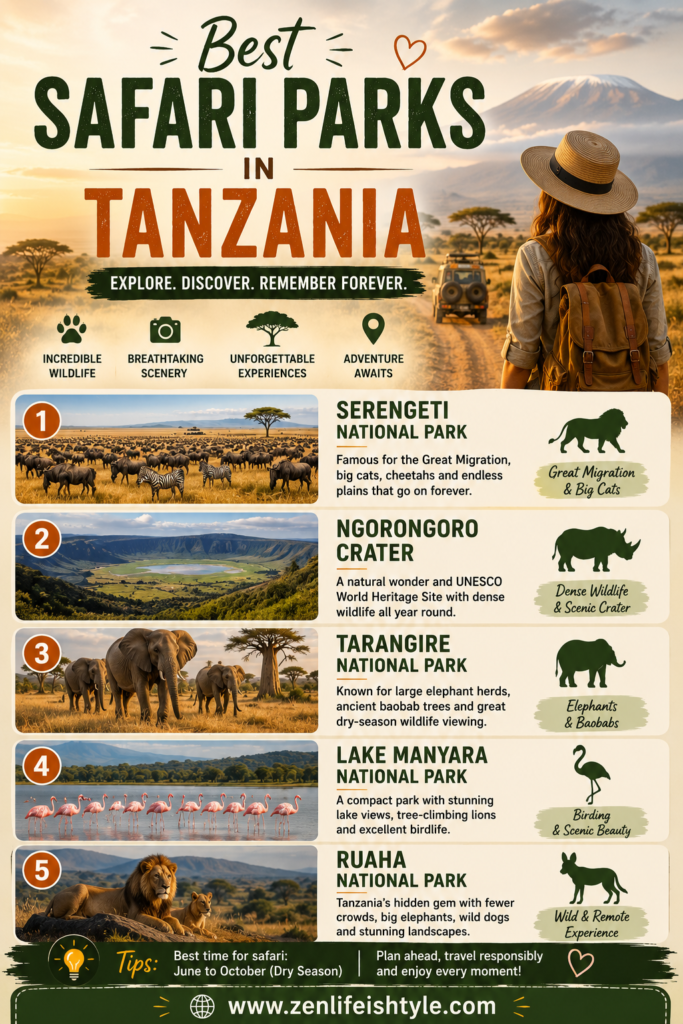
Serengeti National Park — Best for the Great Migration and Big Cats
Serengeti National Park is the most famous place for a Tanzania safari and one of the most iconic safari destinations in the world. If you are dreaming of vast plains, big cats, endless skies, and classic East Africa wildlife scenes, the Serengeti is usually the first place to consider.
The Serengeti plains stretch across a huge area, and the park covers around 5,700 square miles. This landscape is known for open grasslands, acacia trees, safari camps, and excellent wildlife viewing throughout the year.
The biggest highlight is the Great Migration, when millions of wildebeest, zebras, and gazelles move across the Serengeti ecosystem in search of fresh grass and water. The exact movement changes with rainfall and season, but it remains one of the greatest wildlife events in Africa.
The Serengeti is also one of the best places in Tanzania for big cats. Lions are commonly seen in many areas, while cheetahs are often found on the open plains. Leopards are more elusive, but they can sometimes be spotted resting in trees or moving through riverine areas.
Most visitors explore the Serengeti through morning and afternoon game drives with experienced safari guides. You can also add special experiences such as hot air balloon rides, which give you a beautiful aerial view of the plains at sunrise.
Stay in or near Serengeti National Park if you want the Great Migration, big cats, wide open landscapes, safari camps, game drives, and one of the most classic safari experiences in Tanzania.
Ngorongoro Crater — Best for Dense Wildlife and Dramatic Scenery
Ngorongoro Crater is one of the most unique safari places in Tanzania. It sits inside the Ngorongoro Conservation Area and is often included with Serengeti and Tarangire on Tanzania’s popular Northern Circuit safari route.
The crater is known as the world’s largest intact caldera, and the scenery is dramatic from the moment you arrive. You drive down from the Ngorongoro Highlands to the crater floor, where open grasslands, lakes, forests, and wetlands create a rich home for wildlife.
One of the biggest reasons to visit Ngorongoro is the concentration of animals. The crater floor is home to tens of thousands of wildlife, including lions, elephants, buffalo, zebras, wildebeest, hyenas, hippos, and many bird species. It is also one of the better places in Tanzania to look for rhinos, although sightings still depend on luck.
Ngorongoro is also a strong place for travellers who want a chance to see the Big Five in a beautiful and compact area. Because the crater is smaller than the Serengeti, wildlife viewing can feel more concentrated, which is helpful for first-time safari travellers.
Most Ngorongoro visits include a game drive on the crater floor and a picnic lunch at a safe designated area. If you have more time, you can also visit the Olduvai Gorge Museum nearby to learn more about human origins and the deep history of this part of East Africa.
Choose Ngorongoro Crater if you want dramatic scenery, dense wildlife, rhino possibilities, Big Five safari moments, and one of Tanzania’s most memorable natural landscapes.
Tarangire National Park — Best for Elephants and Baobab Landscapes
Tarangire National Park is a great choice if you want elephants, baobab trees, and a safari experience that can feel a little quieter than the Serengeti in some areas. It is part of Tanzania’s popular Northern Circuit, so many travellers include it with Serengeti, Ngorongoro Crater, and Lake Manyara.
Tarangire is especially famous for its large elephant herds. During the dry season, animals gather around the Tarangire River and other water sources, making wildlife viewing easier. This is when the park can be especially rewarding for game drives.
The scenery is also beautiful. Tarangire is known for its huge baobab trees, open landscapes, and classic safari views. You may see elephants, giraffes, zebras, wildebeest, buffalo, antelopes, lions, leopards, and many bird species.
Compared with the Serengeti, Tarangire can sometimes feel more relaxed, depending on the season and route. It may not have the same fame as the Serengeti, but it gives travellers a very strong safari experience, especially if elephants are high on your list.
Choose Tarangire National Park if you want elephant herds, baobab landscapes, dry season wildlife viewing, peaceful game drives, and an excellent stop on Tanzania’s Northern Circuit.
Lake Manyara National Park — Best for Flamingos, Forest and Short Safaris
Lake Manyara National Park is a good choice if you want a shorter safari stop with lake scenery, forest, birdlife, and a different feel from the wide Serengeti plains. It is a smaller park compared to Serengeti or Tarangire, but it can still add nice variety to a Tanzania safari itinerary.
The park sits near the Great Rift Valley and is known for Lake Manyara, forested areas, open spaces, and beautiful views. It is also famous for birding, especially when pink flamingos gather around the lake. Tanzania has more than 400 bird species, and Lake Manyara is one of the places where bird lovers can enjoy a rewarding stop.
Lake Manyara National Park is also known for its tree-top walkway, which gives visitors a different way to experience the forest. Instead of only doing game drives, you can walk above the trees and enjoy the park from another angle.
Wildlife viewing here may include elephants, giraffes, zebras, baboons, hippos, antelopes, and many birds. The park is not usually the main highlight of a Tanzania safari, but it works well as an easy addition from Arusha, especially if you are doing the Northern Circuit.
Choose Lake Manyara National Park if you want flamingos, forest scenery, birding, lake views, a tree-top walkway, and a shorter safari stop that adds variety to Serengeti, Ngorongoro, and Tarangire.
Arusha National Park — Best for Short Safari Trips Near Arusha
Arusha National Park is a good option if you want a short safari experience close to Arusha. It is not usually the main safari destination in Tanzania, but it works well for travellers with limited time or those who want a gentle introduction before visiting bigger parks like Serengeti, Ngorongoro, or Tarangire.
The park is known for Mount Meru, forest scenery, lakes, and views of Mount Kilimanjaro on clear days. The landscapes feel different from the wide Serengeti plains, which makes Arusha National Park a nice change if you enjoy nature, scenery, and shorter activities.
Wildlife viewing can include giraffes, zebras, buffalo, warthogs, monkeys, antelopes, and many bird species. You may not see the same level of big cat action as in Serengeti or Ngorongoro, but the park still offers a peaceful safari experience.
One of the special things about Arusha National Park is that walking safaris may be available in certain areas with expert guides. Canoeing may also be offered when conditions allow, giving travellers a different way to enjoy the park.
Choose Arusha National Park if you want easy access from Arusha, a short safari trip, Mount Meru views, possible Kilimanjaro views, walking safaris where permitted, and a relaxed introduction to Tanzania’s national parks.
Ruaha National Park — Best for Remote Southern Circuit Safaris
Ruaha National Park is a great choice if you want a wilder and quieter Tanzania safari away from the busiest Northern Circuit. It is part of Tanzania’s Southern Circuit, which is known for remote parks, fewer crowds, and a more untouched safari feeling.
Ruaha is especially good for travellers who have already done a classic Serengeti or Ngorongoro safari and now want something more remote. The park has wide landscapes, rivers, baobab trees, beautiful lodges, and a strong sense of wilderness.
Wildlife viewing in Ruaha can include elephants, lions, leopards, buffalo, giraffes, zebras, antelopes, and many other wild animals. The park is also known for predators, so it can be very rewarding for travellers who enjoy big cat sightings and more dramatic safari moments.
Because Ruaha is less crowded than many Northern Circuit parks, game drives can feel more peaceful and personal. Some areas may also offer walking safaris with expert guides, giving travellers a slower and more detailed way to experience the bush.
Ruaha is also a strong option for a private safari, especially if you want a more flexible route, fewer vehicles, and a less commercial safari atmosphere. It may take more planning and cost more to reach than the easier Northern Circuit parks, but the reward is a quieter and more natural safari experience.
Choose Ruaha National Park if you want remote parks, fewer crowds, elephants, predators, walking safaris, beautiful lodges, and a wilder Southern Circuit safari in Tanzania.
Northern Circuit vs Southern Circuit in Tanzania
When planning a Tanzania safari, one of the first things to understand is the difference between the Northern Circuit and the Southern Circuit. Both can offer excellent safari experiences, but they suit different types of travellers.
Safari Route | Best For |
|---|---|
Northern Circuit | First-time visitors, Serengeti, Ngorongoro, Tarangire, Lake Manyara |
Southern Circuit | Remote wilderness, fewer crowds, Ruaha, more off-the-beaten-path safaris |
Zanzibar Add-On | Beach holiday, Stone Town, Indian Ocean relaxation after safari |
The Northern Circuit is the most popular route for a Tanzania safari. It includes famous national parks and safari areas such as Serengeti National Park, Ngorongoro Crater, Tarangire National Park, and Lake Manyara National Park. This route is popular because it is easier to access from Arusha and offers dense wildlife, beautiful landscapes, and a strong classic safari experience.
Most first-time Tanzania safari travellers choose the Northern Circuit because it gives them a good mix of big wildlife, famous parks, and easier logistics. It is also the best route if your dream is to see the Serengeti plains, the Great Migration, Ngorongoro’s crater floor, and Tarangire’s elephant herds.
The Southern Circuit is better for travellers who want something quieter and more remote. Parks like Ruaha National Park offer fewer crowds, wilder landscapes, and a more off-the-beaten-path safari feeling. It may take more planning and can be more expensive to reach, but it is a great choice for repeat safari travellers or anyone who wants a less busy experience.
Many travellers also add Zanzibar Island after safari. This works especially well after the Northern Circuit, giving you a nice balance of wildlife, culture, beach time, Stone Town, and Indian Ocean relaxation.
Best Tanzania Safari Destinations by Travel Style
The best Tanzania safari destination depends on what kind of trip you want. Some areas are better for a first safari, some for the Great Migration, some for elephants, and others for fewer crowds, walking safaris, culture, or a safari and beach holiday.
Travel Style | Best Tanzania Safari Area |
|---|---|
First safari | Serengeti, Ngorongoro, Tarangire |
Great Migration | Serengeti National Park |
Big cats | Serengeti, Ngorongoro |
Elephants | Tarangire, Ruaha |
Birding | Lake Manyara, Tarangire, Arusha |
Luxury safari | Serengeti, Ngorongoro, private safari camps |
Budget safari | Northern Circuit group tours |
Fewer crowds | Ruaha, Southern Circuit |
Walking safaris | Ruaha, selected areas with expert guides |
Culture | Maasai boma visits, Olduvai Gorge, local communities |
Safari + beach holiday | Serengeti or Northern Circuit + Zanzibar Island |
For a first safari, the Northern Circuit is usually the easiest choice. Serengeti, Ngorongoro and Tarangire give you a strong mix of big wildlife, beautiful landscapes, and classic game drives.
If the Great Migration is your main dream, focus on Serengeti National Park and choose the right region based on your travel month. If elephants are high on your list, Tarangire and Ruaha are strong options.
For travellers who want fewer crowds, Ruaha and the Southern Circuit are better choices. For a safari and beach holiday, combine the Serengeti or Northern Circuit with Zanzibar Island for Indian Ocean relaxation after the bush.
What Animals Can You See on a Tanzania Safari?
Tanzania offers some of the best wildlife viewing in Africa, with around 350 species of wild animals and a wide range of landscapes, from the open Serengeti plains to forests, lakes, rivers and crater floors. What you see will depend on the park you visit, the season, your safari guide and a bit of luck.
Many travellers hope to see the Big Five on a Tanzania safari: lions, leopards, elephants, buffalo and rhinos. The Serengeti is one of the best places for big cats, especially lions, cheetahs and leopards. Ngorongoro Crater is one of the better places to look for rhinos, although sightings are never guaranteed.
You may also see wildebeest, zebras, gazelles, giraffes, hippos, crocodiles, hyenas, antelopes and many other wild animals. During the Great Migration, huge herds of wildebeest, zebras and gazelles move across the Serengeti ecosystem in search of fresh grass and water.
If elephants are high on your list, Tarangire National Park is one of the best places to visit, especially during the dry season when animals gather around water sources. For birds, Tanzania is also excellent. Flamingos can be seen in places like Lake Manyara, and the country has more than 400 bird species, making it rewarding for bird lovers as well as big wildlife fans.
The best advice is to enjoy every sighting, not only the famous animals. A Tanzania safari is just as much about the full experience: early morning light, animal tracks, birds calling, giraffes moving across the plains, and unexpected moments that happen when you least expect them.
The Great Migration in Tanzania
The Great Migration is one of the biggest reasons travellers plan a Tanzania safari. It takes place across the Serengeti National Park and the wider Serengeti ecosystem, where huge herds move across the plains in search of fresh grass and water.
The migration includes millions of wildebeest, zebras and gazelles. Every year, over a million wildebeest move through Tanzania, making this one of the most impressive wildlife events in the world. The sight of animals spread across the Serengeti plains is one of the classic images of an African safari.
The migration is often linked to June to October, especially for travellers hoping to see large herds and possible river crossings in the northern Serengeti. These crossings can be dramatic, but they are never guaranteed. The movement of the herds depends on rainfall, grass conditions and natural animal behaviour.
Another important time is the calving season in the southern Serengeti, usually early in the year. This is when many wildebeest give birth, and it can also attract predators such as lions, cheetahs and hyenas.
The most important thing to understand is that the Great Migration is not a fixed event in one place. It moves throughout the year. If you want to plan your safari around the migration, choose the right Serengeti region for your travel month. A good safari guide or operator can help you decide whether to stay in the southern, central, western or northern Serengeti.
Even if you do not see a river crossing, the Serengeti can still offer excellent wildlife viewing. A Tanzania safari should not depend on one single moment. The migration is a highlight, but the full safari experience is much bigger than that.
Best Time to Visit Tanzania for Safari
Dry Season: June to October
From June to October, Tanzania’s dry season is generally the best period for a safari, especially for wildlife viewing. This is when wildlife viewing is often at its strongest because the bush is thinner, grass is shorter, and animals gather around rivers, waterholes, and other permanent water sources.
This period is especially good for Serengeti National Park, Ngorongoro Crater, and Tarangire National Park. In the Serengeti, the dry season is also linked to the Great Migration, although the exact location of the herds depends on rainfall and grass conditions.
July to September is considered peak safari season in Tanzania. This is a popular time for travellers hoping to see large herds, strong predator activity, and possible migration movement in the Serengeti. It is also one of the busiest and most expensive times to travel, so safari lodges, safari camps, and flights should be booked early.
The dry season is a great choice if this is your first Tanzania safari and you want the best chance of classic wildlife viewing. The main thing to remember is that popular parks can be busier, especially around the Serengeti and Ngorongoro, so choosing the right lodge location and itinerary matters.
Green Season: November to March
The Green Season, from November to March, can be a beautiful time to visit Tanzania for safari. This period usually brings occasional rain showers, greener landscapes, softer light, and fewer tourists compared to the peak dry season.
Wildlife viewing is still possible during the Green Season, especially in places like the Serengeti and Ngorongoro. The parks often look fresh and colourful, which can make photography very rewarding. Birding can also be excellent during this period, with many resident and migratory birds active across different safari areas.
Another benefit is that some safari camps may offer lower rates compared to the busiest months. This can make the Green Season a good option for travellers who want better value and fewer vehicles, while still enjoying a strong safari experience.
The main thing to remember is that rain can affect road conditions and daily plans. Showers are often short, but routes can still become muddy in some areas, so it helps to travel with a reliable safari operator and keep your itinerary realistic.
Heavy Rainy Season: April and May
April and May are usually the heavy rainy season months in Tanzania. This period can bring stronger rain, muddy roads, and more travel disruption, especially in remote safari areas.
Wildlife spotting can be harder during the heavy rains because animals may spread out when water is available in many places. The grass can also be taller, which can make it more difficult to see smaller animals or predators during game drives.
Some roads inside the parks can become muddy and slow, especially because many safari routes are unpaved and bumpy even in better weather. Some safari camps may also close during this period, so accommodation choices can be more limited.
The benefit of April and May is that prices may be lower and there are usually fewer tourists. However, for most first-time safari travellers, this is not the easiest period to choose. If you travel during these months, keep the itinerary simple, use a reliable safari operator, and check which lodges and routes are operating before booking.
Best Time by Experience
Here is a simple way to choose the best time to visit Tanzania based on the safari experience you want:
Best for Great Migration: June to October, depending on where the herds are located
Best for general wildlife viewing: June to October
Best for fewer tourists: November to March
Best for birding: Green Season
Best for lower prices: Green Season and rainy months, where camps remain open
Best overall first safari timing: June to October
For most first-time travellers, June to October is the easiest period to choose because wildlife viewing is usually strong and the weather is more reliable. But if you prefer fewer tourists, greener landscapes, and possible lower rates, the Green Season from November to March can still be a very enjoyable time for a Tanzania safari.
Types of Tanzania Safari Experiences
Game Drives
Game drives are the main safari activity in Tanzania and are usually the best way to see wildlife. Most safaris include morning and afternoon game drives in specially designed safari vehicles, with a trained guide who knows the area, animal behaviour, and the best places to look for wildlife.
Game drives often start early in the morning because animals are more active during the cooler hours of the day. This is a good time to look for lions, leopards, hyenas, elephants, buffalo, giraffes, zebras, and other wildlife before the heat becomes too strong.
During the hottest part of the day, many safaris include a break at the lodge or camp. On full-day safari drives, your guide may arrange a picnic lunch in a safe area inside the park, especially in places like Serengeti National Park or Ngorongoro Crater.
A good safari guide can make a big difference to your Tanzania safari experience. They help spot animals, explain tracks and behaviour, position the vehicle safely, and make the game drive more meaningful than simply driving around looking for wildlife.
Private Safari
A private safari is a good choice if you want more comfort, flexibility, and control over your itinerary. Instead of joining a group tour, you have your own safari vehicle, personal guide, and customized itinerary.
This works especially well for families, couples, photographers, and travellers who want to move at their own pace. You can spend longer at sightings, start earlier, stop for photos more often, or adjust the schedule based on your interests.
A private safari is usually more expensive than group tours, but it can make the trip feel smoother and more personal. It is also helpful if you are travelling with children, celebrating a honeymoon, or combining several parks like Serengeti, Ngorongoro, Tarangire and Lake Manyara.
Walking Safaris
Walking safaris give you a slower and more detailed way to experience the bush. Instead of only viewing animals from a vehicle, you walk with expert guides who help you notice tracks, plants, insects, birds, animal signs, and smaller details in the landscape.
Walking safaris are not allowed everywhere in Tanzania. They are only offered in selected areas with trained guides and proper safety rules. Places like Ruaha and some special safari areas may offer walking safaris where permitted.
This type of safari is best for travellers who want to understand nature more deeply. It is less about chasing big sightings and more about learning how the bush works.
Hot Air Balloon Safari
A hot air balloon safari is one of the most memorable add-ons to a Tanzania safari. It is especially popular in the Serengeti, where balloons usually take off around sunrise.
From the air, you can enjoy beautiful aerial views of the plains, wildlife, rivers, and safari landscapes. It gives you a completely different feeling from a normal game drive and can be a special experience for honeymooners, photographers, or travellers planning a once-in-a-lifetime trip.
Hot air balloon rides usually come at an extra cost and should be booked in advance, especially during peak safari season.
Cultural Visits
Cultural visits can add more meaning to your Tanzania safari when they are done respectfully. Many travellers choose to visit a Maasai boma to learn about the Maasai people, their traditions, homes, daily life, and ceremonies.
Some visits may include traditional skills such as spear-throwing, but these should always be offered in a respectful and well-managed way. The goal should be real cultural learning, not making local people feel like a performance.
You can also visit places such as the Shanga social enterprise, where local artisans create handmade products and support inclusive community work. In some itineraries, travellers may visit local primary schools or community projects, but these visits should be handled carefully and ethically.
For history and human origins, the Olduvai Gorge Museum is a valuable stop, especially if you are travelling between Ngorongoro and the Serengeti. It helps connect your safari to the deeper human history of East Africa.
Where to Stay on a Tanzania Safari
Where you stay on a Tanzania safari depends on your budget, route, season, and the kind of safari experience you want. Tanzania has many accommodation options, from budget camping and group tours to beautiful lodges, private safari camps, luxury tented camps, and mobile migration camps.
A safari lodge is a good choice if you want comfort, proper rooms, meals, good service, and easy access to game drives. Many lodges have restaurants, lounges, viewing decks, and sometimes swimming pools. They work well for first-time safari travellers who want a smooth and comfortable experience.
Safari camps and tented camps are also very popular in Tanzania. Some are simple and practical, while others are luxurious, with proper beds, private bathrooms, hot showers, and beautiful views. Tented camps often feel closer to nature because you can hear the sounds of the bush at night and wake up near the wildlife areas.
In the Serengeti, mobile camps can be a good option, especially for travellers following the Great Migration. These camps may move seasonally to stay closer to wildlife movements, giving guests a more flexible and immersive safari experience.
The Northern Circuit has many accommodation options because it is the most popular safari route. You will find lodges and camps around Serengeti, Ngorongoro, Tarangire, Lake Manyara, and Arusha. The Southern Circuit, including Ruaha, has fewer options but often offers a quieter and more remote safari feeling.
Luxury lodges and private safari camps often offer better locations, more personal service, strong guiding, and a calmer atmosphere. They cost more, but they can make the safari feel more relaxed and special.
Choose your accommodation based on what matters most to you: budget, comfort, location, wildlife access, service, and whether you want a classic lodge stay or a more adventurous tented camp experience.
How Much Does a Tanzania Safari Cost?
The cost of a Tanzania safari depends on the season, national park, transport, lodge style, and number of days. Prices are usually quoted per person, and a private safari normally costs more than a group safari because you have your own guide, vehicle, and flexible itinerary.
As a rough current guide, a Tanzania safari can start from around US$200–400 per person per day for budget group safaris, US$400–800 per person per day for mid-range safaris, and US$800–1,500+ per person per day for luxury safaris. Private luxury and ultra-luxury trips can go much higher, especially with fly-in transfers and premium camps.
Safari Style | Approximate Cost | What to Expect |
|---|---|---|
Budget group safari | US$200–400 pp/day | Shared safari vehicles, simple camps or lodges, lower cost |
Mid-range safari | US$400–800 pp/day | Comfortable lodges or tented camps, shared or private vehicle |
Private safari | US$350–700+ pp/day | Custom itinerary, private guide and vehicle, higher cost than group tours |
Luxury safari | US$800–1,500+ pp/day | Premium camps, fly-in options, best locations and service |
Ultra-luxury safari | US$1,500–3,000+ pp/night | Top lodges, private settings, premium service and exclusive experiences |
The Serengeti and Ngorongoro Crater often cost more than shorter parks because of park fees, conservation fees, longer driving distances, and higher lodge prices. Serengeti non-resident park entry is commonly listed around US$70–83 per adult per 24 hours, depending on how the fee and VAT are shown, while other park, concession, camping and vehicle fees may also apply.
Extra costs can include airport transfers, domestic flights, hot air balloon rides, premium drinks, tips, visas, travel insurance, and a Zanzibar add-on. A hot air balloon safari in the Serengeti is usually booked separately, and flights between parks or to Zanzibar can increase the total price.
Before booking, ask exactly what is included: accommodation, meals, park fees, conservation fees, game drives, airport transfers, safari vehicle, guide, drinks, tips, and domestic flights. A cheaper safari may not always be better value if important costs are excluded.
How Many Days Do You Need for a Tanzania Safari?
The number of days you need for a Tanzania safari depends on how many parks you want to visit and whether you want to add Zanzibar Island or Mafia Island after the safari.
If you only have a few days, you can still enjoy a short safari near Arusha. But if you want the full experience with Serengeti National Park, Ngorongoro Crater, Tarangire, and Lake Manyara, it is better to plan at least 6 to 8 days.
Length of Safari | Best For |
|---|---|
3 days | Short Ngorongoro, Tarangire or Lake Manyara safari |
4 to 5 days | Good Northern Circuit introduction |
6 to 8 days | Serengeti, Ngorongoro, Tarangire and Lake Manyara |
10+ days | Tanzania safari plus Zanzibar Island or Mafia Island |
For a first Tanzania safari, a simple plan could be:
2 nights Serengeti + 1 night Ngorongoro
3 nights Serengeti + 2 nights Ngorongoro or Tarangire
7 to 10 days if adding Zanzibar
A short 3-day safari can work if you are limited on time, but it may feel rushed. A 4 to 5 day safari gives you a better introduction to the Northern Circuit, especially if you combine Tarangire, Ngorongoro and Lake Manyara.
For a stronger safari experience, 6 to 8 days is better. This gives you enough time to reach the Serengeti, enjoy more game drives, visit Ngorongoro Crater, and add Tarangire or Lake Manyara without moving too quickly.
If you want safari and beach, plan 10 days or more. This allows you to enjoy the bush first, then relax on Zanzibar Island or Mafia Island by the Indian Ocean. This works especially well for honeymoons, family trips and first-time visitors who want both wildlife and beach time.
Tanzania Safari and Beach Holiday Combinations
A Tanzania safari and beach holiday is one of the best ways to enjoy both adventure and relaxation in one trip. After early morning game drives, dusty roads, and long days in the bush, a few nights by the Indian Ocean can be the perfect way to slow down.
The most popular combination is a Tanzania safari + Zanzibar Island. Many travellers start with the Serengeti, Ngorongoro Crater, Tarangire or Lake Manyara, then fly to Zanzibar for beaches, Stone Town, spice tours, and time by the sea. This works very well for a honeymoon, family trip, or first safari in Tanzania.
A common route is:
Serengeti / Northern Circuit + Zanzibar Island
Ngorongoro and Tarangire + Zanzibar
Tanzania safari + Stone Town + beach resort
Safari + Zanzibar Archipelago island stay
If you want something quieter than Zanzibar, Mafia Island can also be a good option. It is more peaceful and less busy, with a slower island feel. It is a nice choice for travellers who want diving, snorkeling, marine life, and a quieter beach holiday after safari.
Some travellers also connect through Dar es Salaam, especially if they are visiting the southern parks or continuing to the coast. Dar es Salaam is not usually the main beach destination, but it can be useful for flights, transfers, and access to islands.
A safari and beach combination gives you a balanced trip. The safari brings wildlife, landscapes, and adventure, while Zanzibar Island, Mafia Island, or the wider Zanzibar Archipelago gives you rest, warm water, culture, and Indian Ocean views before flying home.
Tanzania Safari Travel Tips for First-Time Visitors
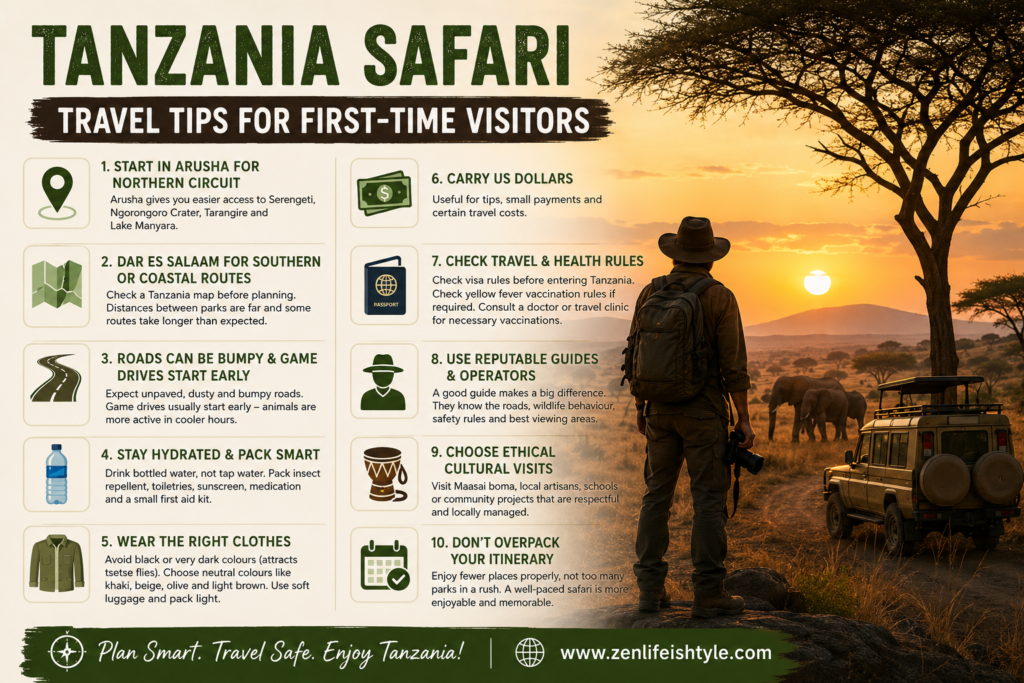
If this is your first Tanzania safari, start by choosing the right route. For most travellers doing the Northern Circuit, it is best to start in Arusha. This gives you easier access to Serengeti National Park, Ngorongoro Crater, Tarangire National Park and Lake Manyara.
Dar es Salaam is more useful if you are planning a southern safari route, a coastal trip, or an island extension. Before booking, look at a Tanzania map so you understand the distance between parks. Tanzania is a big country, and some routes take longer than they look.
Safari roads inside the parks can be unpaved, dusty and bumpy. Game drives also often start early in the morning, so bring layers and be ready for long but rewarding days. The early starts are worth it because animals are more active during the cooler hours.
For health and comfort, drink bottled water and avoid tap water. Pack insect repellent, personal toiletries, sunscreen, medication and a small first aid kit. In remote safari areas, shops are limited, so it is better to bring what you need from the start.
Avoid wearing black or very dark clothing because it can attract tsetse flies in some areas. Neutral colours like khaki, beige, olive and light brown are better for safari. If you are flying between parks, use soft luggage and pack light.
Carry some US dollars for tips, small payments and certain travel costs. Also check visa rules before you enter Tanzania. If you are travelling from or through certain countries, you may need to check yellow fever vaccination rules. It is always advisable to consult a doctor or travel clinic before your trip for vaccination and health advice.
Use reputable safari guides and operators. A good guide can make a huge difference to your safari experience. They know the roads, wildlife behaviour, safety rules and best viewing areas.
If you include cultural visits, choose ethical experiences. Visiting a Maasai boma, local artisans, schools or community projects can be meaningful, but it should be respectful and locally managed.
Finally, do not overpack your itinerary. It is better to enjoy fewer places properly than to rush through too many parks. A well-paced Tanzania safari will feel more enjoyable, less tiring and more memorable.
Final Thoughts
Tanzania is one of Africa’s top safari destinations and a wonderful choice if you want classic wildlife, beautiful landscapes, and a strong East Africa safari experience. From the open Serengeti plains to the dramatic Ngorongoro Crater and the elephant country of Tarangire, each area offers something different.
Choose Serengeti National Park if you want the Great Migration, big cats, wide plains, safari camps, and one of the most famous wildlife experiences in the world. It is the heart of many Tanzania safari itineraries and a strong choice for both first-time and repeat travellers.
Choose Ngorongoro Crater if you want dense wildlife, dramatic scenery, rhino possibilities, and a compact safari experience on the crater floor. It is one of the most memorable places to include on the Northern Circuit.
Choose Tarangire National Park if you want large elephant herds, baobab trees, and rewarding dry-season wildlife viewing. It is a great park to add before or after Serengeti and Ngorongoro.
Choose Lake Manyara National Park if you want birding, flamingos, forest scenery, lake views, and a shorter safari stop near Arusha. It may not be the main highlight for everyone, but it adds nice variety to a Tanzania safari.
Choose Ruaha National Park and the Southern Circuit if you want fewer crowds, remote wilderness, beautiful lodges, predators, elephants, and a quieter safari experience away from the busiest routes.
The best time for a Tanzania safari is usually the dry season from June to October, especially for wildlife viewing and game drives. But the Green Season from November to March can also be beautiful if you want fewer tourists, greener landscapes, birding, and possible lower rates.
A Tanzania safari can be planned in many ways. You can choose a budget group safari, a comfortable mid-range trip, a private safari with your own guide, or a luxury safari with premium camps and fly-in options. If you want to relax after the bush, Zanzibar Island makes a perfect beach extension with Stone Town, white sandy beaches, and Indian Ocean views.
The best Tanzania safari is the one planned around your wildlife goals, budget, season, and preferred travel style.
FAQs
Is Tanzania good for a first safari?
Yes, Tanzania is one of the best countries for a first safari. Tanzania is home to some of Africa’s most famous safari areas, including Serengeti National Park, Ngorongoro Crater, Tarangire National Park, and Lake Manyara National Park. These parks offer strong wildlife viewing, beautiful landscapes, experienced safari guides, and a classic East Africa safari experience.
What is the best safari park in Tanzania?
The Serengeti is usually the best safari park in Tanzania if you want the Great Migration, big cats, wide open plains, and a classic safari experience. Ngorongoro Crater is best for dense wildlife and dramatic scenery, while Tarangire National Park is best for large elephant herds and baobab landscapes.
When is the best time to visit Tanzania for safari?
The best time for a Tanzania safari is usually June to October, when the weather is drier and animals are easier to see. This period is good for wildlife viewing because animals often gather around water and the bush is easier to see through. July to September is peak safari season, while November to March is the Green Season, with fewer tourists, greener landscapes, and good birding.
Can you see the Big Five in Tanzania?
Yes, Tanzania is home to the Big Five: lions, leopards, elephants, buffalo and rhinos. The Serengeti is strong for lions, leopards and cheetahs, Tarangire is excellent for elephants, and Ngorongoro Crater is one of the better places to look for rhinos. However, sightings always depend on the destination, season, guide and luck.
How many days do you need for a Tanzania safari?
For a short Northern Circuit introduction, 4 to 5 days can work well. This gives you time to visit places like Tarangire, Ngorongoro Crater and Lake Manyara. For a stronger Tanzania safari, 6 to 8 days is better, especially if you want to include Serengeti National Park. If you are adding Zanzibar Island or Mafia Island, plan 7 to 10 days or more.
Is a Tanzania safari expensive?
A Tanzania safari can be affordable or expensive depending on your travel style. Budget group tours usually cost less, while private safaris, luxury lodges, premium safari camps and fly-in safaris cost more. The final price depends on the season, parks visited, accommodation, transport, number of days, park fees and activities.
Can you combine Tanzania safari with Zanzibar?
Yes, many travellers combine a Tanzania safari with Zanzibar Island. A common route is Serengeti or the Northern Circuit + Zanzibar, giving you wildlife first and beach time after. You can also add Stone Town, the wider Zanzibar Archipelago, or Mafia Island if you want a quieter island experience.
Is the Great Migration guaranteed in Tanzania?
No, the Great Migration is not guaranteed. The migration is seasonal and depends on rainfall, grass and herd movement. Even during the right months, animals may be in a different part of the Serengeti than expected. The best way to plan is to choose the right Serengeti region for your travel month and treat migration sightings as a natural wildlife experience, not a fixed event.