Packing for an African safari is very different from packing for a normal holiday. A safari trip can include cold mornings, hot afternoons, dusty roads, insects, long game drives and strict luggage limits on small aircraft. What feels unnecessary at home may become extremely useful in the bush, while overpacking can quickly create problems.
The right safari packing list also depends on the type of trip you are taking. A lodge-based safari with daily game drives requires different clothing and footwear from a walking safari, while gorilla trekking calls for stronger shoes, rain protection and clothing suitable for muddy forest trails. Travellers flying between remote camps may also need to follow strict light-aircraft luggage restrictions, including weight limits and soft-sided bags.
You should also think about wildlife photography, easy access to essentials inside safari vehicles and the changing temperatures between early mornings and midday. Fortunately, many safari lodges offer laundry services, which means you can pack fewer clothes and reuse practical outfits throughout the trip.
Conditions can also vary between East Africa and Southern Africa. Kenya and Tanzania may require packing for dusty plains and cool morning drives, while Botswana, Zambia, Zimbabwe and South Africa can have surprisingly cold winter mornings followed by warm afternoons. The season, destination and planned activities all affect what should go into your bag.
This guide is designed for travellers preparing for a first safari, traditional game drives, walking safaris or gorilla trekking. It covers the practical items you genuinely need without encouraging you to pack an entire wardrobe.
For more help planning the wider trip, read our Ultimate African Safari Guide, compare destinations in Best Safari Countries in Africa, and check the seasonal conditions in Best Time for an African Safari.
African Safari Packing List: Quick Checklist
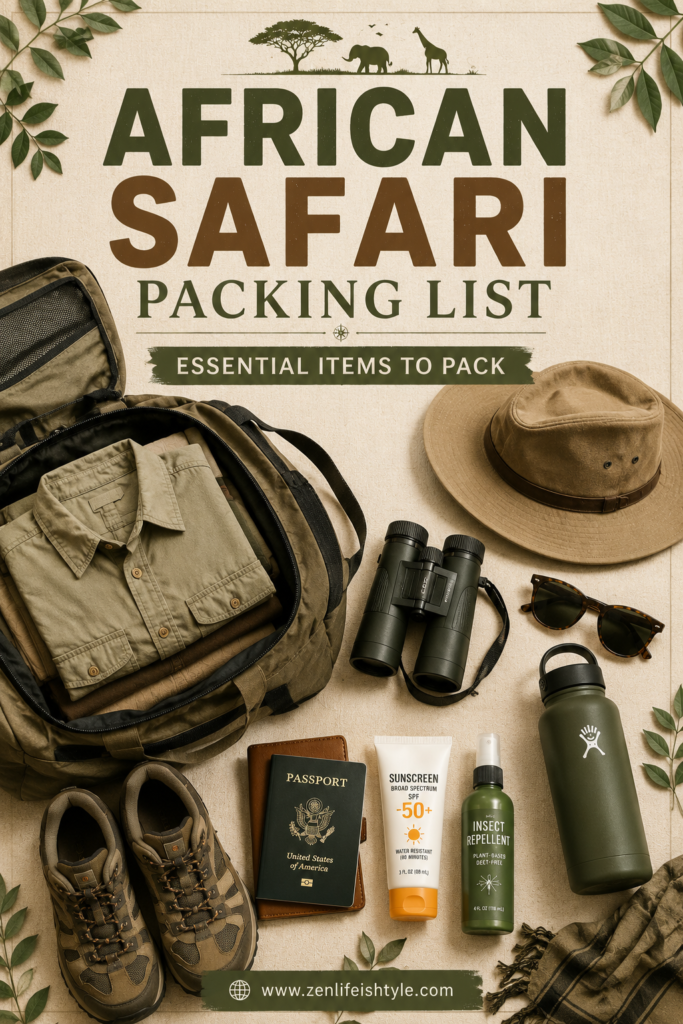
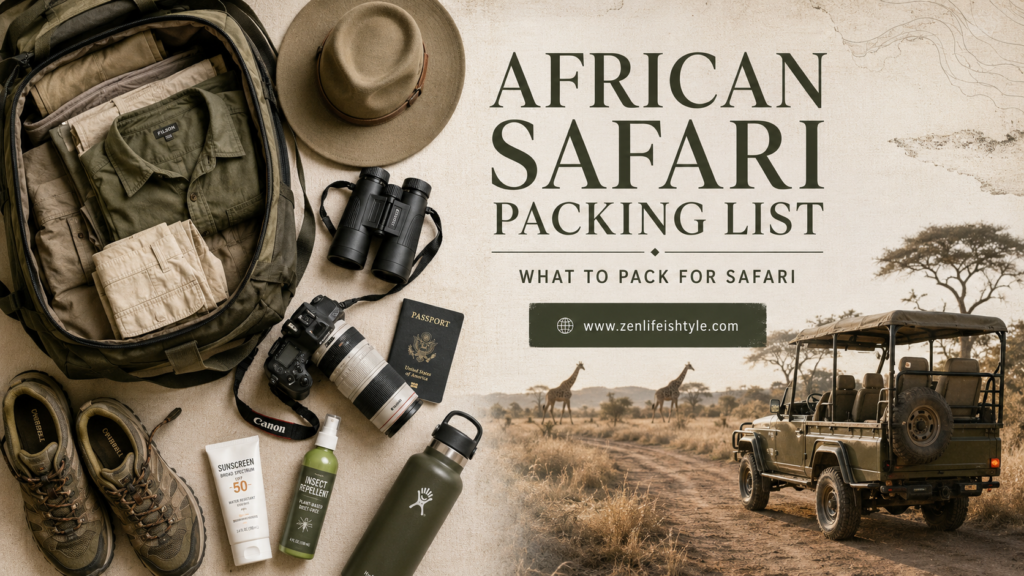
Use this quick African safari packing list as a starting point before adapting it to your destination, season and activities.
Travel Documents
Passport with sufficient validity
Visa or electronic travel authorisation where required
Travel insurance details
Flight tickets and safari itinerary
Vaccination certificate where required
Copies of prescriptions
Emergency contact details
Printed and digital copies of important documents
Safari Clothing
Two or three lightweight short-sleeved shirts
Two long-sleeved shirts
Two pairs of comfortable long trousers
One pair of shorts where appropriate
Lightweight fleece or warm mid-layer
Packable puffer jacket for cold mornings
Breathable underwear and socks
Sleepwear
Swimwear
Simple smart-casual outfit for the lodge
Neutral colours such as khaki, beige, olive or brown
Shoes
Comfortable closed-toe shoes for game drives
Trail shoes or hiking boots for walking safaris
Waterproof hiking boots for gorilla trekking
Sandals or flip-flops for the lodge
Shoes with a secure fit and decent tread
Sun and Insect Protection
Wide-brimmed sun hat
Polarised sunglasses
High-SPF sunscreen
Lip balm with SPF
Effective insect repellent
Long sleeves and trousers for evenings
Bite-relief cream
Reusable water bottle
Toiletries and Medication
Prescription medication
Malaria tablets where prescribed
Pain relief
Antihistamines
Motion sickness tablets
Anti-diarrhoeal medication
Oral rehydration salts
Small first-aid kit
Toothbrush and toothpaste
Deodorant and moisturiser
Hand sanitiser and tissues
Personal hygiene products
Travel-sized toiletries
Camera Gear
DSLR, mirrorless camera or smartphone
Telephoto lens for distant wildlife sightings
Spare batteries
Extra memory cards
Lens-cleaning cloth
Camera strap
Dust or rain protection
Binoculars
Camera beanbag where useful
Electronics
Mobile phone
Portable charger or power bank
Universal travel adaptor
Camera charger
Charging cables
Multi-port charger
Headlamp or small torch
E-reader where useful
Daypack Essentials
Camera
Binoculars
Water bottle
Sunscreen
Insect repellent
Sunglasses
Hat
Lip balm
Light fleece
Packable rain jacket
Tissues
Essential medication
Portable charger
Light-Aircraft Luggage
Soft-sided duffel bag
Small, flexible carry-on bag
Packing cubes
No rigid frame or hard-shell case
Confirmed baggage allowance for every bush flight
Bag dimensions checked before departure
Essential medication and documents kept in hand luggage
Enough spare space for souvenirs
Most travellers do not need a different outfit for every day. Many safari lodges offer laundry service, so a small collection of comfortable, quick-drying clothes is usually more practical than a large suitcase.
What Luggage Should You Take on an African Safari?
The type of luggage you take on an African safari matters more than many travellers expect. On a normal holiday, a large suitcase may be fine. On safari, however, your bag may need to fit inside a small luggage compartment, be loaded into a light aircraft or be carried between remote camps.
If your itinerary includes only road transfers, you may have more flexibility. But if you are using bush flights, the wrong type of bag can cause problems even when it is within the weight limit.
Soft-Sided Duffel Bag
A soft-sided duffel bag is usually the safest choice for safari travel. These bags are flexible, lighter than many suitcases and easier to fit into the narrow luggage compartments used on light aircraft.
Hard-shell cases can be difficult to load because they do not bend or compress. Small aircraft often have limited storage space, and rigid suitcases may not fit through the luggage opening even when they meet the airline’s weight allowance.
Choose a bag without:
A hard outer shell
A rigid frame
Large fixed wheels
Thick internal supports
Bulky handles that cannot fold down
A simple duffel with strong zips, comfortable handles and a shoulder strap is usually more practical. Some travellers also prefer a soft bag with lightweight wheels, but the frame should still be flexible enough for bush-flight storage.
Do not assume that every safari airline follows the same baggage rules. Maximum dimensions and weight limits vary by airline, route and aircraft type. Before packing, check the exact requirements for every internal flight on your itinerary rather than relying only on the rules of your international airline.
The best safari bag is not necessarily the largest one you can take. It is the one that is light, flexible, easy to handle and accepted on every flight in your journey.
Safari Luggage Weight Limits
Safari luggage limits are usually much stricter than the allowances used on international flights. This is because bush aircraft are smaller, have limited storage space and must carefully manage the total weight carried on each route.
A common allowance for safari flights is approximately 15–20 kg per person in total. This may include both your main duffel bag and your hand luggage, so it is important not to assume that your carry-on is separate.
Some Kenyan bush-flight routes, for example, may limit passengers to around 15 kg including hand luggage. Other airlines and destinations may allow closer to 20 kg, but the exact rule depends on the operator, aircraft type and route.
Keep the following points in mind:
Weight limits vary between airlines and destinations.
Hand luggage may be included in the total allowance.
Camera equipment may count toward your baggage weight.
Excess baggage may need to be arranged and paid for in advance.
Extra baggage space is not always guaranteed on the day of travel.
Soft-sided bags are usually required even when your luggage is within the weight limit.
Before departure, ask your safari operator to confirm the exact weight and size limits for every internal flight. This is especially important if your itinerary includes several bush flights operated by different airlines.
The safest approach is to pack below the stated limit rather than exactly at it. A lighter bag is easier to handle, leaves room for souvenirs and reduces the risk of repacking at the airstrip.
Carry-On Bag and Day Pack
Your carry-on bag should hold the items you cannot afford to lose or place out of reach. Keep it small, lightweight and easy to fit inside a safari vehicle or light aircraft.
Important items to keep accessible include:
Passport and travel documents
Essential medication
Camera and memory cards
Binoculars
Portable charger
Sunscreen
Insect repellent
Lip balm
Reusable water bottle
Keep your passport, travel insurance details, permits and copies of important documents together in a waterproof pouch. Prescription medication should always stay in your hand luggage rather than your checked bag.
A small day pack is useful during game drives and safari excursions. It gives you quick access to your camera, binoculars, sun protection and water without having to open your main luggage. Choose a compact bag that closes securely and does not take up too much space inside safari vehicles.
Avoid filling the day pack with unnecessary items. Space inside a safari vehicle may be limited, and a heavy bag can become uncomfortable during long game drives. Pack only what you expect to use during the day and leave bulky items at the lodge.
What Clothes Should You Pack for Safari?
You do not need to buy an entirely new wardrobe for an African safari. Comfortable, lightweight layers are far more useful than expensive safari clothing that you may never wear again.
Safari days can begin with a cold early-morning drive, become hot by midday and cool down again after sunset. The most practical approach is to wear simple layers that can be added or removed as the temperature changes.
Choose clothing that is:
Lightweight
Breathable
Comfortable when sitting for long periods
Easy to wash and quick to dry
Suitable for dust, heat and changing temperatures
A few well-chosen shirts, trousers and warm layers are usually enough, especially when your lodge offers laundry service.
Best Colours for Safari Clothing
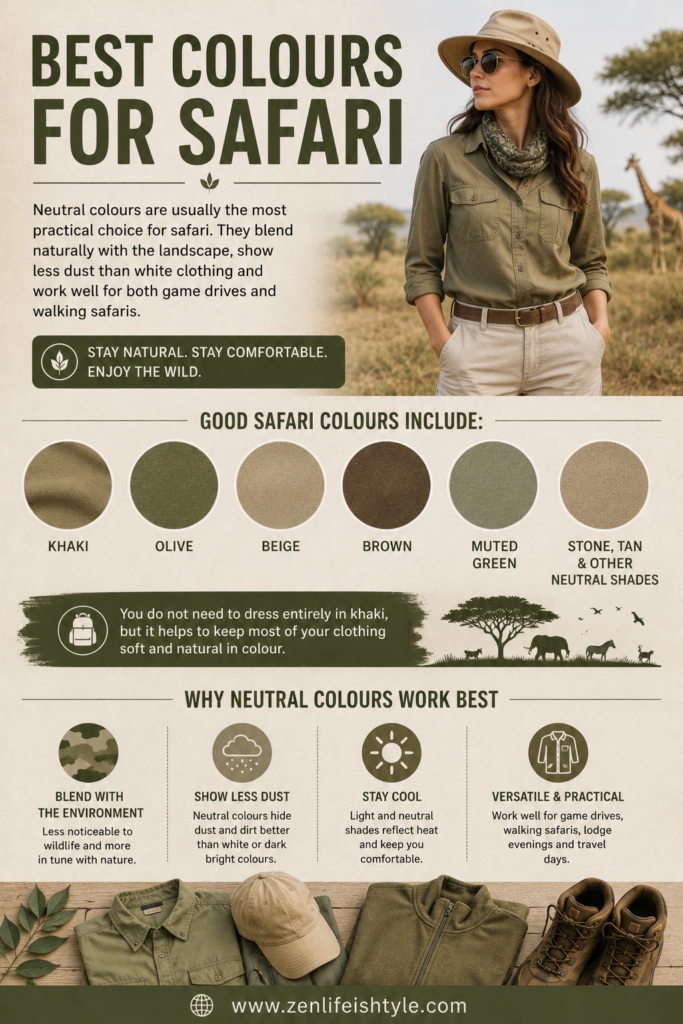
Neutral colours are usually the most practical choice for safari. They blend naturally with the landscape, show less dust than white clothing and work well for both game drives and walking safaris.
Good safari colours include:
Khaki
Olive
Beige
Brown
Muted green
Stone, tan and other neutral shades
You do not need to dress entirely in khaki, but it helps to keep most of your clothing soft and natural in colour.
Very bright colours can feel out of place in the bush and may attract attention during walking safaris. White clothing is also less practical because it quickly shows dust, mud and marks from safari vehicles.
In some parts of Africa where tsetse flies are present, dark blue and black may attract more flies. This does not mean you must avoid every dark item, but lighter neutral colours can be more comfortable in affected areas.
Camouflage clothing is best left at home. In some African countries, military-style camouflage may be restricted, while in others it can simply appear inappropriate. Plain olive, brown or khaki clothing gives you the same practical benefit without creating unnecessary problems.
The goal is not to look like a professional guide. It is to stay comfortable, protected and appropriately dressed for the environment.
Safari Shirts and Tops
For most safari trips, you do not need many tops. A small selection of lightweight shirts is usually enough, especially if your lodge offers laundry service.
Pack:
Two or three short-sleeved shirts
Two long-sleeved shirts
Breathable, quick-drying fabrics
One lightweight base layer
One warmer top or mid-layer
Short-sleeved shirts work well during warmer parts of the day, while long sleeves provide extra protection from the sun, dust and insects. A lightweight base layer is useful for cool mornings, and a warmer layer can be added when temperatures drop.
Avoid heavy fabrics that take a long time to dry. Soft, breathable materials are more comfortable during long days in the bush and easier to wash while travelling.
Safari Trousers and Shorts
Pack around two pairs of lightweight long trousers and one pair of shorts where the weather, activity and local setting make them suitable.
Choose trousers made from comfortable stretch fabric that allows you to climb into safari vehicles, walk on uneven ground and sit comfortably for several hours. Long trousers also provide better protection from insects, dust, branches and strong sunlight.
Shorts can be useful around the lodge or during hot afternoons, but long trousers are often the more practical choice for early drives, evening activities and walking safaris.
The best safari trousers are comfortable enough for long game drives and light enough to wash and dry quickly.
Warm Layers for Morning and Evening Drives
Many travellers are surprised by how cold a safari can feel before sunrise or after sunset. Open safari vehicles provide little protection from wind, and early game drives can begin when temperatures are still very low.
Bring:
A good fleece
A lightweight puffer jacket
A wind-resistant outer layer
Warm socks
An optional scarf or beanie
Layering is especially important for winter safaris in Southern Africa, high-altitude destinations and early departures. Cold flights in small aircraft can also make a warm jacket useful.
Wear several light layers rather than one very heavy coat. You can remove them gradually as the day becomes warmer and put them back on for an evening drive.
Some safari lodges provide blankets or hot water bottles for cold morning drives, but it is still best to bring your own warm clothing.
Underwear and Sleepwear
Pack comfortable underwear that works well in warm weather and dries quickly after washing. A supportive sports bra can be particularly useful because safari roads are often rough and uneven.
You may also want to bring:
Lightweight sleepwear
Comfortable socks
A swimsuit for lodges with pools
A small laundry bag for used clothing
Keep this part of your packing simple. Safari lodges are usually relaxed, and comfort is more important than bringing a different outfit for every day.
What Shoes Should You Pack for Safari?
The right shoes for safari depend on how active your itinerary will be. Travellers spending most of their time on game drives need something very different from those joining a walking safari or gorilla trek.
Shoes for Game Drives
For a vehicle-based safari, comfortable closed-toe shoes are usually the best choice. Lightweight trainers or casual walking shoes work well because they are easy to wear, practical in dusty conditions and comfortable when getting in and out of safari vehicles.
Choose shoes with:
A secure fit
Breathable material
A sole with decent tread
Enough comfort for long periods of sitting and short walks around camp
Heavy hiking boots are often unnecessary for standard game drives. They can take up too much luggage space, feel hot during the day and add unnecessary weight, especially when travelling on light aircraft.
Hiking Boots for a Walking Safari
Proper hiking boots or supportive trail shoes are more important if your itinerary includes:
A walking safari
Gorilla trekking
Rocky or uneven terrain
Wet forest trails
Look for footwear with good grip, ankle support where needed and a comfortable fit that has already been tested before the trip. Do not take brand-new boots on safari without wearing them in first, as blisters can quickly ruin a walking or trekking day.
Water-resistant or waterproof footwear is especially useful for gorilla trekking and rainy-season travel, when trails may be muddy and slippery.
Additional Footwear
A pair of flip-flops or lightweight sandals is useful around the lodge, by the pool or between activities. You may also want one pair of simple casual shoes if your itinerary includes city hotels or restaurants.
Try not to pack too many shoes. For most safari trips, one practical closed-toe pair, one walking or hiking pair where necessary, and one pair of lodge sandals will be enough.
What to Pack for a Walking Safari
A walking safari requires more practical clothing and footwear than a standard game drive. You will be moving through uneven terrain, exposed to the sun and spending more time outside the protection of a safari vehicle.
Pack:
Hiking boots or trail shoes with decent tread
Lightweight long trousers
Long-sleeved shirts
Neutral-coloured clothing
A small day pack
Reusable water bottle
Wide-brimmed hat
High-SPF sunscreen
Insect repellent
Lightweight fleece
Binoculars
Good footwear is especially important. Your shoes should be comfortable, supportive and already worn in before the trip. Long trousers and long sleeves help protect against sun, insects, dust and thorny vegetation, while neutral clothing is more suitable for moving quietly through the bush.
A small day pack should hold only the essentials, including water, sunscreen, insect repellent, a light layer and binoculars. Avoid carrying too much, as even a short walk can feel tiring in warm conditions.
Walking safaris often begin early, when temperatures can still be cool, so a lightweight fleece may be useful at the start. As the day warms up, it should be easy to remove and pack away.
Zambia is one of Africa’s best-known walking safari destinations. For more information on South Luangwa, Kafue and other safari areas, read our Zambia Safari Guide.
What to Pack for Gorilla Trekking
Gorilla trekking requires more preparation than a standard game drive. In places such as Bwindi in Uganda and Volcanoes National Park in Rwanda, trails can be steep, muddy and slippery. Rain can also arrive with little warning, even during the drier months.
Pack the following:
Waterproof hiking boots with reliable grip
Lightweight long trousers
Long-sleeved shirt
Waterproof or water-resistant rain jacket
Gardening gloves or trekking gloves
Gaiters
Small waterproof day pack
Insect repellent
Reusable water bottle
Extra pair of socks
Waterproof protection for your camera
Waterproof hiking boots are one of the most important items. The trails can cross wet ground, thick vegetation and uneven slopes, so ordinary trainers may not provide enough grip or protection. Wear the boots before your trip to make sure they are comfortable.
Long trousers and a long-sleeved shirt help protect your skin from insects, mud, stinging plants and branches. Gardening gloves may sound unusual, but they can be useful when you need to hold onto vegetation for balance. Gaiters add another layer of protection by keeping mud, water and small insects away from your socks and lower legs.
Keep your rain jacket near the top of your day pack rather than buried underneath other items. A small waterproof backpack or rain cover will help protect your documents, phone, camera and spare clothing.
Carry enough water for the trek, along with insect repellent and an extra pair of socks. Camera equipment should be protected with a waterproof cover or sealed dry bag, especially if rain is expected.
The trek may last anything from a short walk to several hours, depending on where the gorilla family is located. Pack light, but make sure the items you carry are suitable for rain, mud and uneven forest terrain.
Sun Protection for an African Safari
Sun protection is essential on safari, even during cooler months or early morning game drives. The African sun can become intense quickly, especially in open vehicles where there is little shade.
Pack:
A wide-brimmed hat
A sun hat with a chin strap
High-SPF sunscreen
Polarized sunglasses
Lip balm with SPF
Lightweight long sleeves
A reusable water bottle
A wide-brimmed hat protects your face, ears and neck more effectively than a standard cap. A chin strap is useful in open safari vehicles, where wind can easily blow a loose hat away.
Apply high-SPF sunscreen before leaving for a game drive and reapply during the day, especially after sweating. Do not forget your ears, neck, hands and lips, which are often exposed for long periods.
Polarized sunglasses can reduce glare and make it more comfortable to scan open landscapes and waterholes. Long-sleeved shirts also provide extra protection without requiring constant sunscreen application.
Staying hydrated is just as important as protecting your skin. Carry a reusable water bottle and drink regularly, even when the weather feels cool. Dry air, wind and long hours outdoors can cause dehydration before you notice it.
Insect Repellent and Mosquito Protection
Mosquito and insect protection should be part of every African safari packing list. Even where insects are not a major problem during the day, bites can become more common around sunrise, sunset and after rain.
Pack:
Effective insect repellent
Long-sleeved shirts
Lightweight long trousers
Antihistamine cream
Bite-relief treatment
Any mosquito protection recommended for your accommodation
Malaria medication where prescribed
Apply insect repellent to exposed skin and reapply it according to the product instructions. Long sleeves and trousers can provide extra protection during evening drives, outdoor dinners and time around rivers or wetlands.
A small antihistamine cream or bite-relief treatment can help with itching and irritation if you are bitten. Some lodges provide mosquito nets, room sprays or other protection, but it is still sensible to carry your own repellent.
Malaria risk is not the same across every African country or even within every region of one country. For example, the CDC recommends prescription malaria-prevention medicine for travellers visiting certain parts of Kenya. The right medication depends on your route, health history and other personal factors. (CDC)
Speak to a qualified travel-health professional before your trip and provide your full itinerary, including cities, national parks and remote safari areas. Do not choose malaria medication based only on a packing list or advice from other travellers. If medication is prescribed, follow the instructions for taking it before, during and after your trip.
Toiletries and Personal Care Items
Keep your toiletries simple and travel-sized. Safari luggage limits can be strict, and many lodges already provide basic bathroom products.
Pack:
Toothbrush and toothpaste
Deodorant
Moisturiser
Lip balm
Hand sanitiser
Wet wipes
Small tissues
Personal hygiene products
Travel-sized shampoo and conditioner
Hair ties
Basic shaving items
Many safari lodges provide soap, shampoo, conditioner and body lotion, although the exact products vary. Check with your lodge before travelling so that you do not carry items that will already be available.
Moisturiser and lip balm are especially useful in dry, dusty conditions. Hand sanitiser, tissues and wet wipes can also be helpful during long transfers or days spent away from the lodge.
Hair dryers may not be available at remote camps, and some lodges do not allow guests to use personal hair dryers because their electricity is generated by solar power or a small generator. If this matters to you, ask the lodge before packing one.
Unscented or lightly scented products are often more practical in the bush. Strong perfumes and heavily fragranced toiletries can attract insects and may feel uncomfortable in warm weather.
Keep liquids securely sealed inside a waterproof toiletry bag. A leaking bottle inside a soft-sided duffel can quickly damage clothing, documents and camera accessories.
Safari First-Aid and Medication Packing List
A small personal first-aid kit can be very useful on safari, especially when travelling between remote camps or spending several hours away from the lodge. It should support minor problems, not replace professional medical care.
Pack:
Prescription medication
Copies of prescriptions
Pain relief
Antihistamines
Motion sickness tablets
Oral rehydration salts
Anti-diarrhoeal medication
Plasters
Antiseptic
Blister treatment
Malaria prophylaxis where prescribed
Any vaccination certificates required for your itinerary
Carry enough prescription medication for the entire trip, plus a small extra supply in case of delays. Keep essential medication in your hand luggage rather than your main duffel bag. It is also sensible to carry a copy of each prescription and leave medicines in their original labelled packaging.
Motion sickness tablets may be useful for travellers who are sensitive to rough safari roads or small aircraft. Oral rehydration salts can help after dehydration or stomach illness, while plasters, antiseptic and blister treatment are practical for minor cuts and walking-related discomfort.
Medical and vaccination requirements vary according to the countries, regions and activities included in your itinerary. Malaria prevention may be advised for some destinations, but the correct medication depends on your health, route and travel dates.
Speak to a doctor or qualified travel-health professional well before departure. Give them your complete itinerary so they can advise you on vaccinations, malaria prevention and any personal health precautions. A packing list can help you prepare, but it should not be used as a substitute for individual medical advice.
Travel Documents for an African Safari
Check your travel documents well before departure. Safari itineraries often cross more than one country, and each destination can have different rules for passports, visas, travel authorisations and vaccination records.
Keep the following documents organised and easy to reach:
Passport
Visa or electronic travel authorisation where required
Travel insurance certificate and emergency-assistance details
International and domestic flight tickets
Safari itinerary and accommodation confirmations
Emergency contact information
Vaccination certificate where required
Copies of prescriptions
Photocopies of important documents
Secure digital copies stored online or on your phone
Many destinations require a passport with at least six months of validity remaining, but the exact rule can depend on the country, nationality and itinerary. Some countries also require one or more blank passport pages. Check every destination and transit country rather than assuming that one rule applies across Africa.
For Kenya, most foreign visitors who are not covered by an exemption must complete the official electronic travel authorisation process before travelling. The official application requirements include a passport valid for at least six months from the planned date of arrival and at least one blank page. Because exemptions apply to certain travellers, confirm your eligibility through the official Kenya eTA system before applying.
Keep your passport, authorisation confirmations, insurance details, medication and vaccination documents in your carry-on bag. Do not place the only copies inside checked luggage.
It is sensible to carry one paper photocopy of your passport identification page and save digital copies of your passport, insurance certificate, itinerary and prescriptions. Store them securely and separately from the originals so they remain accessible if a document is lost or stolen.
Entry requirements can change, so check official immigration and health guidance again shortly before departure. Your safari operator can help explain the itinerary, but the traveller remains responsible for carrying the correct documents.
Camera Gear for an African Safari
Wildlife sightings often happen at a distance, so the most useful camera equipment is not always the largest collection of lenses. A simple setup that is easy to carry and quick to use is usually more practical than a heavy bag filled with equipment.
Consider packing:
DSLR or mirrorless camera
Telephoto lens
Extra lenses only where genuinely useful
Spare batteries
Extra memory cards
Lens-cleaning cloth
Dust protection
Camera beanbag
Waterproof cover
Comfortable camera strap
Binoculars
A telephoto lens is especially valuable on safari because animals may be far from the vehicle or separated by rivers, grassland or thick vegetation. In many situations, one reliable telephoto lens will be more useful than carrying several heavy lenses that you rarely change.
If you do bring extra lenses, choose them for a clear purpose. A wider lens can be useful for landscapes, lodge photography and large elephant herds, while a telephoto lens is better for birds, predators and distant wildlife.
Pack spare batteries and memory cards because game drives can be long and charging opportunities may be limited at remote camps. Keep them in your day pack so they are easy to reach when needed.
Dust is one of the biggest challenges for safari photography. Carry a lens-cleaning cloth and avoid changing lenses unnecessarily while the vehicle is moving. A simple protective cover or sealed bag can help keep dust away from your camera when travelling on dry roads.
A camera beanbag can provide useful support on the side of a safari vehicle without taking up as much space as a tripod. A waterproof cover is also worth carrying during the green season, river activities or gorilla trekking.
Use a secure, comfortable camera strap and keep the camera within reach during game drives. Wildlife moments can happen suddenly, and equipment stored at the bottom of a bag may be too slow to access.
Do not forget binoculars. They improve wildlife viewing even when you are not taking photographs and are especially useful for birds, distant animals and scanning open landscapes.
Electronics to Pack for Safari
Safari electronics should be practical, compact and easy to recharge. Remote camps may have limited electricity, shared charging stations or specific hours when power is available, so it helps to plan ahead.
Pack:
Mobile phone
Portable charger
Universal travel adaptor
Charging cables
Power bank
Camera battery charger
Headlamp or small torch
E-reader
Multi-port charger for multiple devices
A power bank is especially useful during long game drives, bush flights and transfers when you may not have access to a plug. Keep it fully charged and pack it in your hand luggage, as airline rules usually require spare lithium batteries and power banks to travel in the cabin rather than checked baggage.
A universal travel adaptor is useful because plug types can vary between African countries and lodges. A multi-port charger can also save space and make it easier to charge a phone, camera batteries and other devices from a single outlet.
Bring all the charging cables you need and label them if you are travelling with several devices. Spare camera batteries are valuable because wildlife drives can last for hours and charging facilities may not always be available between activities.
A headlamp or small torch is useful for walking between your room and the main lodge after dark. It also leaves your hands free, which can be helpful on uneven paths.
An e-reader is lighter than carrying several books and is useful during flights, transfers and quiet afternoons at camp. Download anything you need before arriving, as internet access may be slow or unavailable.
Some safari lodges run on solar power or generators and may switch electricity off overnight. Others have designated charging areas rather than sockets in every room. Check with your lodge in advance so you know what to expect.
What to Keep in Your Safari Day Pack
A small safari day pack keeps your essentials within reach during game drives, walking activities and transfers. It should be compact enough to fit comfortably at your feet or beside your seat without taking up too much space inside the safari vehicle.
Pack:
Camera
Binoculars
Reusable water bottle
Sunscreen
Insect repellent
Lip balm
Sunglasses
Hat
Light fleece
Packable rain jacket
Tissues
Essential medication
Portable charger
Keep your camera and binoculars near the top of the bag so you can reach them quickly when wildlife appears. Sunscreen, insect repellent and lip balm should also be easy to access, as you may need to reapply them during the day.
A light fleece is useful for cold morning drives, while a packable rain jacket provides protection during sudden showers. Carry only the medication you may need during the activity and leave the rest securely stored at the lodge.
Avoid turning your day pack into a second suitcase. Large bags can be awkward in safari vehicles and may reduce the space available for cameras, passengers and other equipment. A lightweight bag with secure zips and a few organised compartments is usually enough.
Laundry Service at Safari Lodges
Many safari lodges and camps offer a laundry service, which makes it possible to pack far fewer clothes than you might for a normal holiday. Instead of bringing a fresh outfit for every day, you can rotate a small collection of practical shirts, trousers and socks.
Laundry may be:
Included in the accommodation rate
Available for an additional charge
Offered daily
Collected in the morning and returned later that day or the following day
The exact service varies between lodges, so check before departure. Remote camps may have different arrangements from larger hotels, and laundry may take longer during bad weather or when water is limited.
Some camps do not wash underwear for cultural reasons. Where this applies, the lodge may provide washing powder so guests can wash small personal items themselves. Packing quick-drying underwear and clothing makes this much easier.
Lightweight, breathable fabrics are ideal because they wash easily and dry faster than heavy cotton or denim. This is especially useful when moving between several camps.
Using lodge laundry services helps reduce your luggage weight, which is important when travelling on light aircraft. In most cases, you do not need a new safari outfit for every day. A few comfortable, washable pieces are usually enough.
Packing Cubes and Safari Organisation
Packing cubes are useful on safari because they keep a soft-sided duffel organised without adding much weight. They also make it easier to find what you need when moving between several lodges or camps.
Use packing cubes to:
Separate clean and dirty clothing
Compress soft clothing
Organise underwear, socks and small items
Make frequent lodge changes quicker
Keep essentials accessible inside a duffel bag
A simple system works well: one cube for shirts, one for trousers and warm layers, one for underwear and socks, and a separate pouch for dirty laundry. This prevents you from unpacking the entire bag every time you need one item.
Packing cubes are especially helpful with soft luggage because duffel bags do not have the same structure as a suitcase. They stop clothing from shifting around and make it easier to repack before a bush flight.
Avoid filling every cube completely. Leave some space in your bag for souvenirs, gifts or extra items collected during the trip. A little spare room also makes it easier to stay within luggage limits on the return journey.
What Not to Pack for an African Safari
Packing light is not only about meeting baggage limits. It also makes transfers easier, reduces clutter inside safari vehicles and helps you focus on items you will genuinely use.
Try to leave the following at home:
Hard-shell luggage when using bush flights
Too many pairs of shoes
Formal clothing
Heavy jewellery
Large amounts of cash
Excessive camera equipment
Strongly scented products
Bright white clothing
Camouflage clothing
Unnecessary valuables
Plastic carrier bags where restricted
Hard-shell suitcases can be difficult to fit into the small luggage compartments used on bush aircraft. Too many shoes, formal outfits and heavy accessories also take up valuable space without adding much to the safari experience.
Avoid travelling with expensive jewellery or valuables that are not essential. Safari camps are generally relaxed, and there is rarely a need to dress formally. A simple smart-casual outfit is usually enough for dinner at most lodges.
Camera equipment should also be chosen carefully. One dependable camera body and a useful telephoto lens may serve you better than several heavy lenses that increase your luggage weight and are difficult to manage during game drives.
Strong perfumes and heavily scented personal-care products are best avoided because they may attract insects and can feel overpowering in warm conditions. Bright white clothes are also impractical because they show dust and stains quickly.
Camouflage clothing may be restricted, associated with military use or considered inappropriate in some African countries. Plain khaki, olive, beige and brown clothing offers a similar practical look without the risk of misunderstanding.
Plastic-bag rules vary between countries, so check the regulations for every destination before travelling. Kenya, for example, prohibits the use and importation of certain plastic carrier and flat bags used for household or commercial packaging. Travellers should use reusable fabric bags or suitable toiletry pouches instead. (NEMA)
The aim is not to pack for every possible situation. It is to remove anything bulky, fragile, restricted or unnecessary before it becomes a problem during the trip.
Safari Dress Code at Lodges
Most safari lodges have a relaxed dress code. Comfort and practicality matter more than formal clothing, and guests are rarely expected to dress up after a day of game drives or outdoor activities.
For dinner, pack:
Smart-casual clothing
Lightweight trousers or a simple dress
Sandals or casual shoes
A warm layer for outdoor dining
A clean shirt, blouse, lightweight trousers or an easy dress is usually enough for the evening. Many lodge meals are served in open dining areas, on decks or around a campfire, so a fleece, cardigan or light jacket can be useful after sunset.
Formal evening wear is generally unnecessary. Suits, high heels and heavy occasion clothing take up space and are not practical for bush camps. The main exceptions are itineraries that include a luxury city hotel, cruise, formal restaurant or special celebration.
Choose simple clothes that are comfortable, easy to pack and suitable for both dinner and relaxing around the lodge.
What to Pack for Safari by Season
Your safari packing list should reflect the season, not only the destination. Dry-season safaris can bring dust and very cold mornings, while green-season trips may involve rain, mud and higher insect activity.
Dry-Season Safari Packing
The dry season is often associated with warm days and clear skies, but early mornings and evening drives can be surprisingly cold. Open safari vehicles also make wind chill more noticeable.
Pack:
Lightweight layers
Warm fleece
Packable puffer jacket
Lip balm
Dust protection
High-SPF sunscreen
Neutral-coloured clothing
Layers allow you to start the morning warmly dressed and remove clothing as temperatures rise. A fleece and lightweight puffer jacket are particularly useful during winter safaris in Southern Africa and on early game drives.
Dry air, dust and wind can affect your skin, lips, eyes and camera equipment. Carry lip balm, sunglasses and a light scarf or buff that can cover your mouth and nose on dusty roads. A lens-cleaning cloth and protective camera bag are also useful.
Do not underestimate sun exposure during cooler weather. High-SPF sunscreen and a wide-brimmed hat are still necessary, even when the air feels cold.
Green-Season Safari Packing
Green-season travel brings fresh landscapes, dramatic skies and excellent birdlife, but you should be prepared for rain, mud and changing conditions.
Pack:
Lightweight rain jacket
Quick-drying clothing
Waterproof cover for your day pack
Extra insect repellent
Waterproof footwear
Camera rain cover
Choose a rain jacket that is light enough to carry during every activity. Heavy waterproof coats can become uncomfortable in warm, humid conditions, while a packable shell provides protection without taking up much space.
Quick-drying shirts, trousers and socks are more practical than heavy fabrics. Waterproof footwear is useful for muddy paths, wet lodge grounds and walking activities, but it should remain breathable enough for warmer temperatures.
The green season may bring increased mosquito and insect activity, so pack enough insect repellent for the full trip. Protect cameras, phones and documents with waterproof covers, sealed pouches or dry bags.
For help choosing between dry-season and green-season travel, read our Best Time for an African Safari.
East Africa Safari Packing List
Packing for East Africa depends on whether your itinerary focuses on game drives, the Great Migration, gorilla trekking or a combination of all three. Kenya, Tanzania, Uganda and Rwanda can involve very different landscapes, but a light, layered and well-organised packing approach works across the region.
If your trip includes internal flights, check the luggage rules before packing. Bush flights in Kenya and Tanzania often have lower weight limits than international airlines and may require soft-sided bags. Your hand luggage, camera equipment and main bag may all be counted within the total allowance.
Cool mornings are common on early game drives, even when afternoons become hot. Pack a fleece or light jacket that can be removed as the temperature rises. Open safari vehicles can also feel cold when moving before sunrise.
Dust is another important consideration, particularly during dry-season drives in Kenya and Tanzania. A lightweight scarf or buff can help protect your face, while a lens-cleaning cloth and secure camera cover will help keep dust away from your equipment.
For Great Migration game drives, keep binoculars, a telephoto lens, spare batteries and memory cards in your day pack. Wildlife may appear at a distance, and long drives can mean limited access to charging facilities during the day.
Trips to Uganda or Rwanda may include gorilla trekking, which requires more specialised equipment. Bring waterproof hiking boots, long trousers, a long-sleeved shirt, rain protection, gloves, gaiters and a waterproof cover for your day pack and camera.
Rain protection is useful throughout East Africa, even outside the main rainy seasons. A light, packable jacket is more practical than a bulky coat and can remain in your day pack without taking up much space.
In certain safari areas, tsetse flies may be present. They can be attracted to dark blue and black, so neutral shades such as khaki, beige, olive and muted green may be more practical. Effective insect repellent, long sleeves and lightweight long trousers can provide additional protection.
For destination-specific planning, read our Kenya Safari Guide and Tanzania Safari Guide.
Southern Africa Safari Packing List
Packing for Southern Africa requires preparation for strong temperature changes. Botswana, Zambia, Zimbabwe, Namibia and South Africa can have cold winter mornings, warm afternoons and very hot conditions later in the dry season.
For early game drives, bring:
Lightweight base layers
A warm fleece
Packable puffer jacket
Wind-resistant outer layer
Warm socks
Optional beanie or scarf
Winter mornings from around June to August can feel much colder than expected, especially in open safari vehicles. The wind created while driving adds to the chill, so dress in layers that can be removed as the day warms.
If your itinerary includes a walking safari, bring comfortable hiking boots or trail shoes with reliable tread, lightweight long trousers, long sleeves, a wide-brimmed hat and a small day pack. Zambia is particularly well known for walking safaris, and practical footwear matters more here than it does on a vehicle-only trip.
Southern Africa also offers many river and boat activities. Chobe, the Okavango Delta, Lower Zambezi and the Zambezi River may involve boat safaris, canoe trips or river cruises. Pack a light windproof layer, secure sun hat, polarized sunglasses and waterproof protection for your phone and camera.
At Victoria Falls, spray can soak clothing and camera equipment when water levels are high. Bring a lightweight rain jacket, quick-drying clothes, shoes with good grip and a waterproof pouch or cover for valuables.
Later in the dry season, particularly around September and October, temperatures can become extremely hot in parts of Botswana, Zambia and Zimbabwe. Pack breathable clothing, high-SPF sunscreen, a reusable water bottle and effective sun protection. Early starts may still feel cool, so do not remove every warm layer from your bag.
Namibia can also have sharp differences between daytime and nighttime temperatures, especially in desert regions. South Africa’s climate varies widely, so the clothing needed for Kruger may differ from what you wear in Cape Town.
For more destination-specific advice, read our Botswana Safari Guide, Zambia Safari Guide and Victoria Falls Travel Guide.
African Safari Packing List for Women
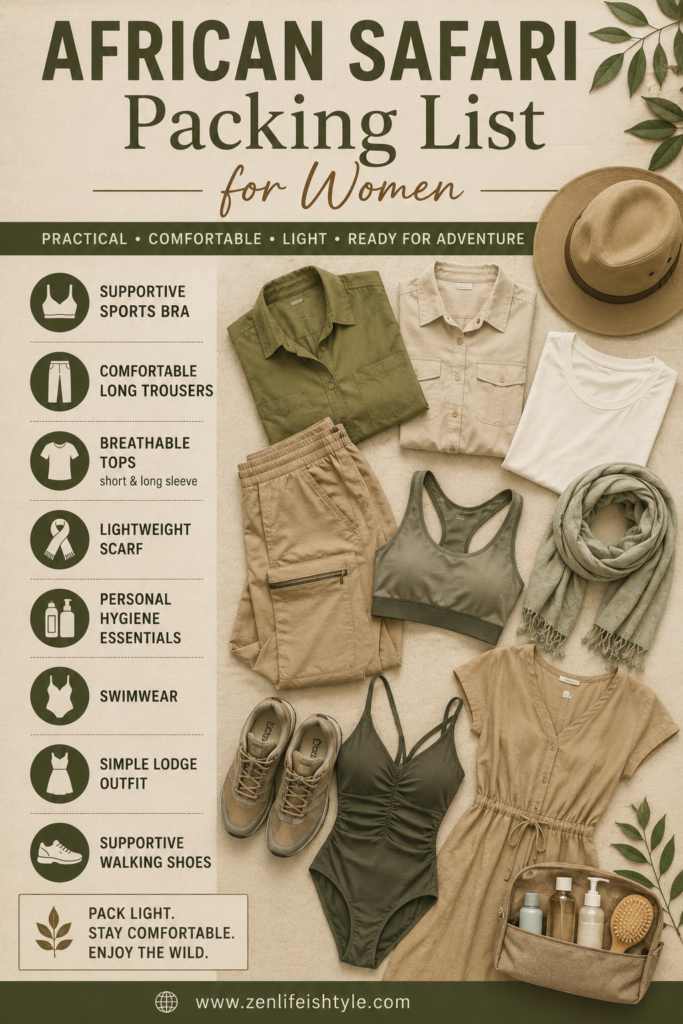
A practical safari wardrobe for women should focus on comfort, movement and changing weather rather than fashion rules. The same basic principles apply to everyone: pack light, choose breathable fabrics and bring clothing that works for long drives, outdoor activities and relaxed lodge evenings.
Useful items include:
Supportive sports bra
Comfortable long trousers
Breathable short- and long-sleeved tops
Lightweight scarf
Personal hygiene products
Swimwear
Simple lodge outfit
Supportive walking shoes
A sports bra can make rough roads and long game drives more comfortable. Lightweight long trousers protect against sun, insects and dust, while breathable tops help with heat during the day.
A scarf is useful for several reasons. It can provide warmth on a cool morning drive, protect your face from dust or cover your shoulders when needed. Choose one that is light and easy to pack.
Bring enough personal hygiene products for the trip, especially if you are staying in remote camps where shops are not easily accessible. Keep essential items in your carry-on bag in case your main luggage is delayed.
Swimwear is worth packing because many safari lodges have pools, particularly in warmer destinations. For evenings, one simple lodge outfit is usually enough. This could be lightweight trousers with a clean top or a comfortable dress with sandals.
Supportive walking shoes are important for uneven lodge paths, nature walks and more active safari excursions. If your trip includes a walking safari or gorilla trekking, choose proper hiking or trail footwear instead.
The aim is to pack clothes that feel comfortable, practical and easy to rewear. There is no need for a separate safari wardrobe or formal evening clothing.
African Safari Packing List for Men
A safari packing list for men should stay simple and practical. The most useful clothes are lightweight, comfortable and suitable for changing temperatures rather than formal or specialised safari wear.
Useful items include:
Lightweight trousers
Breathable shirts
Long-sleeved layer
Warm fleece
Comfortable closed-toe shoes
Swimwear
Simple evening clothing
Wide-brimmed hat and sunglasses
Lightweight trousers work well for game drives, lodge time and casual walks. Choose fabrics that are breathable, quick to dry and comfortable when sitting for several hours.
Pack a mix of short-sleeved shirts and one or two long-sleeved tops. Long sleeves provide extra protection from sun, insects and cool morning air without adding much weight.
A fleece is useful for early drives, evening activities and cold flights. Even in warm destinations, open safari vehicles can feel surprisingly chilly before sunrise.
Comfortable closed-toe shoes are suitable for most vehicle-based safaris. If your itinerary includes a walking safari or gorilla trekking, bring proper trail shoes or hiking boots instead.
Swimwear is useful at lodges with pools, while one clean shirt with lightweight trousers is usually enough for dinner. Safari lodges are generally relaxed, so formal evening clothing is rarely necessary.
Finish the packing list with a secure hat and good sunglasses. These are simple items, but they make a noticeable difference during long hours in the African sun.
Final African Safari Packing Checklist
Use this checklist as a final review before departure. Adjust it for your destination, season, activities and airline baggage rules.
Documents
☐ Passport
☐ Visa or electronic travel authorisation where required
☐ Travel insurance certificate
☐ International and domestic flight tickets
☐ Safari itinerary and accommodation confirmations
☐ Emergency contact details
☐ Vaccination certificate where required
☐ Copies of prescriptions
☐ Photocopy of passport identification page
☐ Secure digital copies of important documents
Luggage
☐ Soft-sided duffel bag
☐ Small carry-on bag
☐ Compact safari day pack
☐ Packing cubes
☐ Waterproof document pouch
☐ Laundry bag
☐ Luggage tags
☐ Bush-flight weight allowance confirmed
☐ Bag dimensions checked
☐ Spare room left for souvenirs
Clothing
☐ Two or three short-sleeved shirts
☐ Two long-sleeved shirts
☐ Two pairs of lightweight long trousers
☐ One pair of shorts where appropriate
☐ Lightweight base layer
☐ Warm fleece
☐ Packable puffer jacket
☐ Wind-resistant layer
☐ Comfortable underwear
☐ Sports bra where needed
☐ Warm and lightweight socks
☐ Sleepwear
☐ Swimwear
☐ Simple smart-casual lodge outfit
☐ Lightweight rain jacket
☐ Neutral-coloured clothing
Shoes
☐ Comfortable closed-toe shoes
☐ Lightweight trainers
☐ Hiking boots or trail shoes where required
☐ Waterproof footwear for gorilla trekking
☐ Sandals or flip-flops for the lodge
☐ Shoes worn in before departure
☐ Spare laces where useful
Health
☐ Prescription medication
☐ Extra supply of essential medication
☐ Copies of prescriptions
☐ Pain relief
☐ Antihistamines
☐ Motion sickness tablets
☐ Oral rehydration salts
☐ Anti-diarrhoeal medication
☐ Plasters
☐ Antiseptic
☐ Blister treatment
☐ Malaria medication where prescribed
☐ Personal first-aid kit
☐ Travel-health consultation completed
Sun and Insect Protection
☐ Wide-brimmed hat
☐ Hat with chin strap
☐ High-SPF sunscreen
☐ Polarized sunglasses
☐ Lip balm with SPF
☐ Effective insect repellent
☐ Bite-relief cream
☐ Long sleeves for evenings
☐ Lightweight long trousers
☐ Reusable water bottle
Camera Gear
☐ DSLR, mirrorless camera or smartphone
☐ Telephoto lens
☐ Wide-angle lens where useful
☐ Spare camera batteries
☐ Extra memory cards
☐ Lens-cleaning cloth
☐ Camera strap
☐ Camera beanbag
☐ Dust protection
☐ Waterproof camera cover
☐ Binoculars
Electronics
☐ Mobile phone
☐ Portable charger
☐ Power bank
☐ Universal travel adaptor
☐ Charging cables
☐ Camera battery charger
☐ Multi-port charger
☐ Headlamp or small torch
☐ E-reader
☐ Offline maps and travel documents downloaded
Day Pack
☐ Camera
☐ Binoculars
☐ Water bottle
☐ Sunscreen
☐ Insect repellent
☐ Lip balm
☐ Sunglasses
☐ Hat
☐ Light fleece
☐ Packable rain jacket
☐ Tissues
☐ Essential medication
☐ Portable charger
☐ Passport and documents when required
Before closing your bag, weigh it again and check the luggage rules for every flight on your itinerary. Your international allowance may be much higher than the limit used on a bush flight.
Final Thoughts
Packing for an African safari becomes much easier when you focus on practicality rather than preparing for every possible situation. Pack light, choose a soft-sided duffel and confirm the weight and size restrictions for every flight on your itinerary, especially if you will travel on small bush aircraft.
Neutral, breathable layers are usually the most useful clothing choice. They work well for changing temperatures, dusty roads, long game drives and outdoor activities. Proper sun protection and insect repellent should also be treated as essentials rather than optional extras.
Keep your passport, travel documents, prescription medication and other important items in your hand luggage. This ensures they remain accessible during transfers and protects you if your main bag is delayed.
Lodge laundry services can help you travel with fewer clothes, so there is no need to pack a new outfit for every day. A small collection of comfortable, quick-drying items is often enough for an entire safari.
Most importantly, adapt this packing list to your destination, season and activities. A vehicle-based safari in South Africa requires different equipment from a walking safari in Zambia or gorilla trekking in Uganda and Rwanda.
The best safari packing list is not the longest one—it is the one that keeps you comfortable, protected and within your luggage allowance.
FAQs About African Safari Packing
What should I pack for an African safari?
Pack lightweight neutral clothing, comfortable closed-toe shoes, sun protection, insect repellent, essential medication, travel documents, a small day pack, binoculars and basic camera gear. If your itinerary includes bush flights, use a soft-sided duffel and confirm the luggage allowance before travelling.
For wider safari planning advice, read our [Ultimate African Safari Guide – INSERT LINK].
What should I wear on safari in Africa?
Wear breathable layers in neutral colours such as khaki, beige, olive, brown or muted green. Long trousers and long sleeves provide protection from sun, insects and dust, while a fleece or lightweight jacket is useful for cold morning and evening drives.
Can I wear jeans on safari?
Yes, you can wear jeans on safari, but they are often heavier, hotter and slower to dry than lightweight travel trousers. Jeans may be fine for cooler weather or lodge evenings, but breathable, quick-drying trousers are usually more comfortable for game drives and walking safaris.
What colours should I avoid on safari?
Avoid very bright colours, bright white clothing and military-style camouflage. White becomes dusty quickly, while camouflage may be restricted or considered inappropriate in some countries. Dark blue and black may also be less practical in areas where tsetse flies are present.
Do I need hiking boots for safari?
You usually do not need heavy hiking boots for vehicle-based game drives. Comfortable trainers or closed-toe walking shoes are normally enough. Hiking boots or supportive trail shoes are recommended for walking safaris, gorilla trekking and itineraries involving rocky, muddy or uneven terrain.
For walking safari planning, read our [Zambia Safari Guide – INSERT LINK].
Can I take a suitcase on a safari?
You may be able to take a suitcase if your itinerary uses road transfers only. However, hard-shell suitcases are often unsuitable for bush flights because they may not fit into small aircraft luggage compartments. A flexible soft-sided duffel is usually the safest option.
How much luggage can I take on a bush flight?
Bush-flight allowances commonly range from approximately 15 to 20 kg per person, sometimes including hand luggage and camera equipment. Limits vary by airline, route and aircraft, so confirm the exact weight and bag dimensions with your safari operator before departure.
Is there a dress code at safari lodges?
Most safari lodges have a relaxed dress code. Smart-casual clothing is usually enough for dinner, such as lightweight trousers, a simple dress, a clean shirt, sandals or casual shoes. Formal evening wear is rarely necessary unless your itinerary includes a luxury city hotel or special event.
Should I take binoculars on safari?
Yes. Binoculars make it much easier to see birds, predators and animals that are far from the vehicle. Even travellers carrying a camera with a telephoto lens will benefit from having binoculars available during game drives.
What should I pack for a 10-day African safari?
For a 10-day safari, pack a small collection of reusable clothing rather than ten separate outfits. Two or three short-sleeved shirts, two long-sleeved shirts, two pairs of lightweight trousers, one warm layer, one rain jacket, comfortable shoes, lodge sandals and essential toiletries are usually enough if laundry service is available.
You should also carry sun protection, insect repellent, medication, travel documents, camera equipment and a compact day pack. Adjust the list for the season, country and activities included in your itinerary.
For seasonal guidance, read our Best Time for an African Safari.