Introduction
Planning your first safari is exciting, but it can also feel a little overwhelming.
You start with one simple idea — “I want to go on an African safari” — and suddenly you are comparing countries, national parks, safari lodges, game drives, walking safaris, luxury camps and self-drive routes. It is easy to wonder whether you are choosing the right destination or making the trip more complicated than it needs to be.
The truth is, the best safari for first-time visitors is not the same for everyone.
Your ideal first safari depends on what matters most to you. You may be dreaming of seeing lions and elephants, following the Great Migration, spotting as many animals as possible or simply enjoying the feeling of being out in the African bush. Your budget, travel style, preferred level of comfort and the amount of time you have will all shape the right safari experience.
Ease of access matters too. Some travellers want a simple trip with good roads, short transfers and comfortable lodges. Others are happy to fly into remote camps or spend several hours travelling between parks if it means a quieter and more exclusive safari holiday.
You should also think about the kind of safari you want. Are you looking for a classic safari with daily game drives? Would you prefer a luxury safari with private guides and beautiful camps? Does a walking safari sound exciting, or would you rather explore at your own pace on a self-drive trip?
The good news is that you do not need to understand every national park, safari destination or wildlife reserve in Africa before you book your first trip. You only need to be clear about your priorities and choose a destination that matches them.
This guide will help you compare the best safari options for first timers, including South Africa, Tanzania, Kenya, Botswana, Namibia, Zambia and Zimbabwe. We will look at wildlife viewing, travel time, cost, comfort and the type of safari experience each destination offers, so you can choose with confidence.
Before you go further, you may also find our Ultimate African Safari Guide, Best Safari Countries in Africa, How Much Does an African Safari Cost? and Best Time for an African Safari useful as you plan the wider trip.
What Is the Best Safari for First-Time Visitors?
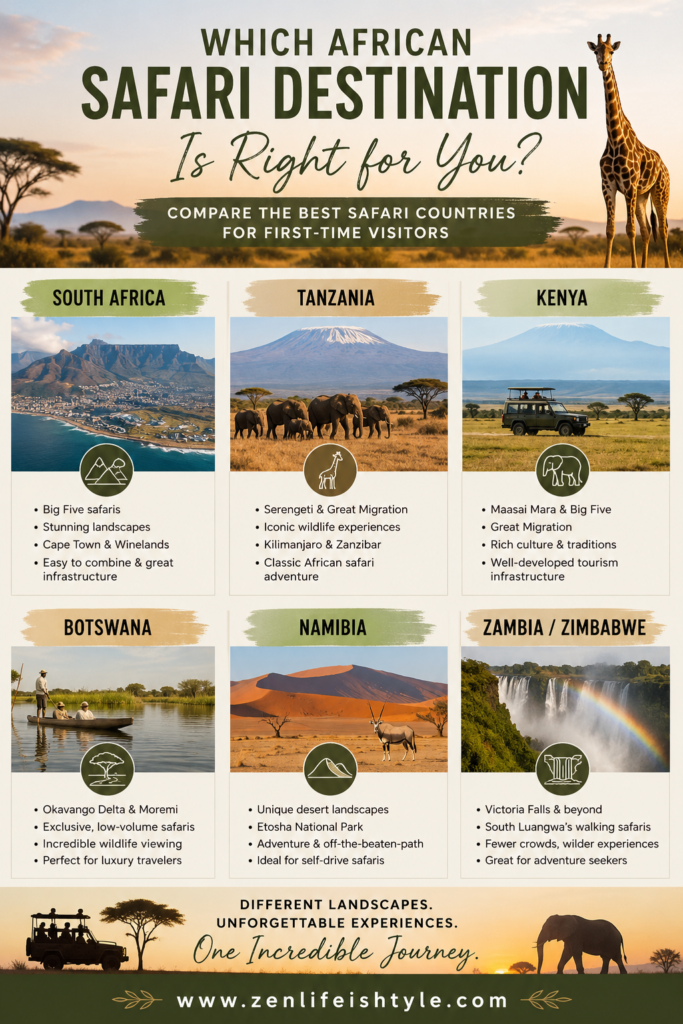
For the vast majority of first-time safari travellers, South Africa offers the easiest introduction, while Tanzania and Kenya provide the most recognisable classic safari experience.
The best choice depends on the kind of trip you want, but these are the strongest options for most first timers:
1. South Africa — Best for Easy Logistics and Variety
South Africa is often the easiest place to begin because it combines excellent wildlife viewing with good roads, reliable flights and a wide choice of accommodation.
You can visit Kruger National Park, stay in a private reserve such as Sabi Sands and add a few days in Cape Town without making the trip feel too complicated. There are also both guided and self-drive options, which makes South Africa suitable for different budgets and travel styles.
2. Tanzania — Best for the Classic Safari Experience
Tanzania is a strong choice if your idea of safari includes wide-open plains, huge herds and dramatic landscapes.
The northern safari circuit combines Serengeti National Park with the Ngorongoro Crater, giving first-time visitors a good mix of game drives, scenery and wildlife viewing. It is also one of the best places to experience different stages of the Great Migration.
3. Kenya — Best for the Maasai Mara and Big Cats
Kenya offers the classic East Africa safari experience many travellers imagine before their first trip.
The Maasai Mara is known for open grasslands, big cats and the seasonal movement of wildebeest and zebra from the Serengeti. Kenya also works well for travellers who want to combine wildlife with cultural experiences or a beach stay.
4. Botswana — Best for an Exclusive Luxury Safari
Botswana is ideal for travellers who want fewer vehicles, remote camps and a more private safari experience.
The Okavango Delta offers game drives, boat safaris and mokoro excursions, while Chobe National Park is especially well known for its large elephant concentrations. Botswana is usually more expensive, but the quality of guiding and wilderness experience can be exceptional.
5. Namibia — Best for Self-Drive Safaris and Desert Landscapes
Namibia is a good choice for confident travellers who enjoy road trips and exploring at their own pace.
Etosha National Park offers accessible wildlife viewing around waterholes, while the wider country adds desert scenery, dunes and dramatic open landscapes. It is less like a traditional guided East African safari and more like a safari road-trip adventure.
6. Zambia or Zimbabwe — Best for Walking Safaris and Victoria Falls
Zambia and Zimbabwe are excellent choices for first-time visitors who want something more active and adventurous.
Zambia is especially known for walking safaris, while Zimbabwe combines strong wildlife areas with easy access to Victoria Falls. Both destinations can offer smaller camps, fewer crowds and a more intimate connection with the African bush.
Quick Answer
Choose:
South Africa for the easiest and most flexible first safari
Tanzania for Serengeti and Ngorongoro Crater
Kenya for Maasai Mara, big cats and classic East Africa scenery
Botswana for luxury and exclusivity
Namibia for self-drive travel
Zambia or Zimbabwe for walking safaris and Victoria Falls
There is no single safari destination that is perfect for everyone. The best safari for first-time visitors is the one that matches your wildlife goals, budget, preferred comfort level and the amount of time you have.
Quick Comparison Table
Destination | Best For | Typical Experience | Best Time |
|---|---|---|---|
South Africa | Easy first safari | Kruger, private reserves and luxury lodges | May–September |
Tanzania | Classic wildlife and scenery | Serengeti and Ngorongoro Crater | June–October |
Kenya | Great Migration and big cats | Maasai Mara | July–October |
Botswana | Exclusive luxury safari | Okavango Delta and Chobe | May–October |
Namibia | Self-drive safari | Etosha and desert landscapes | May–October |
Zambia | Walking safaris | South Luangwa and Lower Zambezi | June–October |
Zimbabwe | Safari and Victoria Falls | Hwange, Mana Pools and Victoria Falls | May–October |
What Makes a Safari Destination Good for First Timers?
A good first safari destination should offer more than famous wildlife.
Seeing lions, elephants, giraffes and other iconic animals is obviously part of the appeal, but the overall experience also depends on how easy the trip is to organise, how comfortable the transfers are and how reliably you can spend time viewing wildlife.
For first-time visitors, the best destinations usually combine strong wildlife viewing with good infrastructure and experienced guides.
Here are the main things to consider.
Reliable Wildlife Viewing
Your first safari should give you a realistic chance of seeing a wide variety of animals without spending the entire trip searching.
Parks with healthy wildlife populations, dependable water sources and experienced guides often provide a more rewarding introduction than remote areas where sightings may be less predictable.
This does not mean every game drive will produce dramatic encounters. Wildlife is never guaranteed. However, choosing a destination known for consistent sightings can make your first safari feel more exciting and less frustrating.
Good Roads, Airstrips and Transfers
Travel between safari destinations can take longer than many first-time visitors expect.
Some parks are reached by road, while others require small aircraft, boat transfers or long drives through remote areas. Good roads, reliable airstrips and organised transfers make the journey much easier, especially if you only have a few days available.
Shorter and smoother transfers also mean you spend more time enjoying the safari and less time moving between camps.
Experienced Guides
A good guide can completely change your safari experience.
Experienced guides do much more than locate animals. They explain behaviour, identify tracks, understand the landscape and help you notice details you might otherwise miss.
They also know when to stay at a sighting, when to move on and how to position the vehicle without disturbing the animals. For a first safari, knowledgeable guiding is often just as important as the park itself.
A Good Choice of Safari Camps and Lodges
The right destination should offer accommodation that suits your preferred level of comfort and budget.
Some travellers want a traditional lodge with a swimming pool, restaurant and solid rooms. Others prefer a tented camp that feels closer to the wilderness. Luxury travellers may want private decks, personalised service and more exclusive locations.
A destination with several accommodation styles gives you more freedom to choose the safari experience that suits you.
Easy Access From Major Cities
For first-time travellers, accessibility matters.
A safari destination that connects easily with a major city or international airport is usually simpler to include in a wider trip. South Africa, for example, works well because travellers can combine a safari with Cape Town or Johannesburg. Victoria Falls can also be paired with safari destinations in Zimbabwe, Zambia or Botswana.
Easy access reduces complicated travel arrangements and makes the trip feel more manageable.
Appropriate Medical and Safety Support
Safari destinations are often remote, so it is important to understand what support is available.
Well-established safari regions usually have clearer emergency procedures, trained staff and access to medical assistance when needed. Travellers should still arrange suitable travel insurance and follow destination-specific health advice, but good local support provides extra reassurance.
This can be particularly important for families, older travellers or anyone visiting Africa for the first time.
Shorter Transfer Times Where Possible
A long transfer is not always a problem, especially when travelling through beautiful scenery. However, too many long journeys can make a short safari feel rushed and tiring.
For most first timers, it is better to spend longer in one or two well-chosen safari areas than to move quickly through several parks.
A simple itinerary often creates a better safari experience than an ambitious route with too many stops.
Flexibility for Different Budgets
Safari costs vary enormously.
Some destinations offer everything from public camps and self-drive travel to private reserves and luxury lodges. Others focus mainly on high-end, fly-in safaris.
For a first trip, a destination with different price levels gives you more flexibility. It also allows you to spend more on the parts of the trip that matter most to you, such as a private vehicle, a special lodge or an extra night in a key wildlife area.
Activities Beyond Game Drives
Game drives are the heart of most safari holidays, but they are not the only way to experience the wilderness.
Depending on the destination, you may also be able to enjoy:
Walking safaris
Boat cruises
Canoe or mokoro trips
Night drives
Birdwatching
Cultural visits
Scenic flights
Photography-focused activities
A variety of activities can make the trip more interesting, particularly if you are staying for several nights.
Opportunities to Combine Two Parks or Destinations
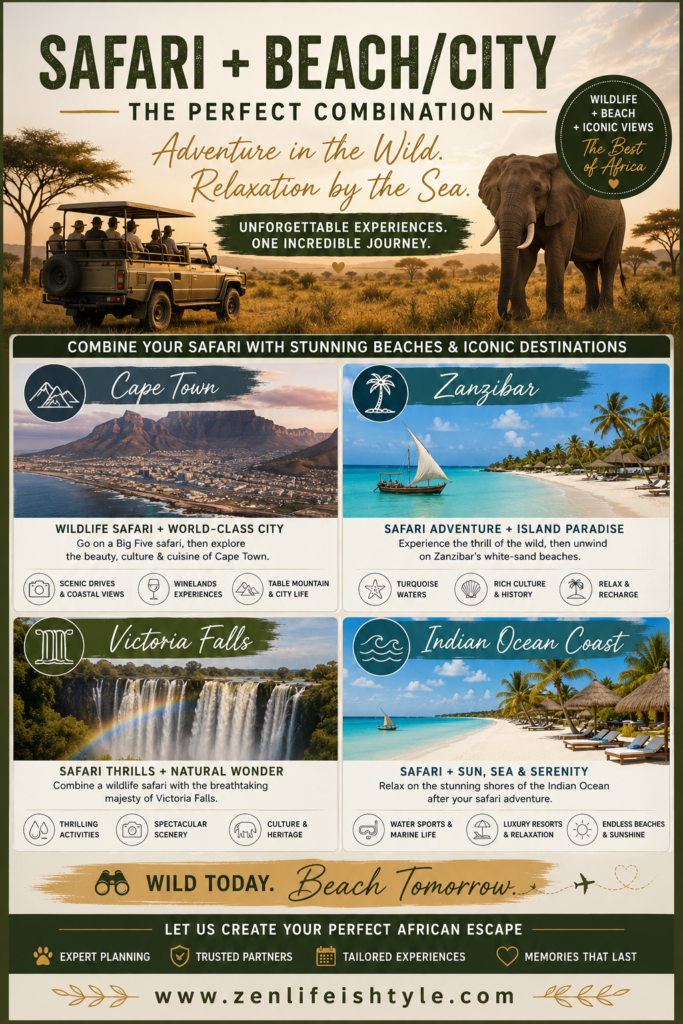
Many first-time safari travellers enjoy combining two different environments.
For example, you might visit the Serengeti and Ngorongoro Crater, combine Kruger with a private reserve, or pair Chobe National Park with Victoria Falls.
Two carefully selected destinations can offer more variety without making the trip overly complicated.
The key is balance. You want enough contrast to make the journey interesting, but not so many transfers that the safari becomes exhausting.
For most first timers, high-density wildlife viewing, good guides and excellent infrastructure matter more than choosing the most remote park in Africa. A well-organised safari in an accessible destination will often be far more enjoyable than a complicated journey built around a park simply because it sounds adventurous.
1. South Africa: Best Overall Safari for First-Time Visitors
South Africa is often the easiest and most flexible place to begin your first safari.
It offers excellent wildlife viewing, good infrastructure, a wide range of accommodation and relatively straightforward connections from major cities. You can choose between self-drive travel, guided game drives, private reserves, luxury lodges and malaria-free safari areas, all within one country.
That flexibility makes South Africa especially appealing for first timers. Families, couples, solo travellers and luxury travellers can all build very different safari holidays without needing to plan an overly complicated itinerary.
Why South Africa Works Well for a First Safari
One of South Africa’s biggest advantages is how easy it is to organise.
Road and flight connections are generally good, transfers are well established and there is a large tourism industry supporting safari travel. You can fly from Johannesburg to an airport near Kruger National Park, drive yourself into the park or arrange a guided transfer directly to a lodge.
South Africa also offers one of the widest accommodation ranges in Africa. Depending on your budget, you can stay in:
Public rest camps
Family-friendly lodges
Small safari camps
Private game reserves
Luxury lodges
Exclusive villas
The quality of guiding is another major strength. Many lodges employ highly trained guides and trackers who can explain animal behaviour, identify tracks and help you understand the wider ecosystem rather than simply pointing out animals.
South Africa also works well for travellers who want more than a safari. You can combine wildlife viewing with Cape Town, the Winelands, the Garden Route or a beach stay without crossing several borders.
For families, malaria-free reserves in areas such as the Eastern Cape and parts of the North West Province can make planning easier. These destinations may be especially useful for travellers with young children or anyone who prefers to avoid malaria-risk areas.
Kruger National Park
Kruger National Park is one of Africa’s best-known safari parks and one of the strongest choices for a first safari.
The park covers more than 7,500 square miles, so it is large enough to offer varied landscapes, different habitats and substantial wildlife populations. Visitors have opportunities to see elephants, lions, leopards, buffalo, rhinos, giraffes, zebras, antelope and many other species.
Big Five sightings are possible, although no animal encounter can ever be guaranteed.
One reason Kruger is so accessible is the choice between self-drive and guided game drives.
Independent travellers can rent a vehicle and explore the park’s road network at their own pace. This can make a Kruger safari more affordable and gives you the freedom to stop whenever you spot wildlife.
Travellers who prefer more support can join guided drives or stay at a lodge where game drives are included. A good guide can help you find animals, explain what you are seeing and make the entire experience feel more meaningful.
Accommodation ranges from traditional camps inside the national park to comfortable lodges and high-end properties around its borders. This makes Kruger suitable for many different budgets rather than only luxury travellers.
Sabi Sands and Other Private Reserves
For travellers seeking a more exclusive safari experience, private reserves such as Sabi Sands are an excellent alternative or addition to Kruger.
Many private reserves share unfenced boundaries with the greater Kruger ecosystem, allowing animals to move naturally between areas.
The main advantages often include:
Smaller numbers of safari vehicles
Highly experienced guides and trackers
Off-road wildlife viewing where permitted
Night drives
More flexible game-drive schedules
Strong opportunities for close predator sightings
Luxury safari accommodation
Off-road driving can make a major difference when tracking lions or leopards because guides may be able to leave the main roads and position the vehicle closer to the sighting, while still following reserve rules.
Night drives also allow visitors to search for nocturnal animals that are less active during the day.
Private reserves are usually more expensive than self-driving in Kruger, but they often include accommodation, meals and guided activities. For travellers who want comfort, personalised service and fewer vehicles, the extra cost may be worthwhile.
A popular first-time itinerary combines a few nights in Kruger National Park with a few nights in a private reserve. This gives you the freedom and scale of the national park alongside the guiding and exclusivity of a private safari experience.
Combine Safari With Cape Town
South Africa offers one of the easiest safari-and-city combinations in Africa.
You can begin with game drives in Kruger or a private reserve and then fly to Cape Town for mountains, beaches, restaurants, history and nearby wine regions. This creates a varied trip without requiring complicated international transfers.
It also works well for travellers who are unsure whether they want their entire holiday to focus on wildlife. A few days on safari followed by time in Cape Town can make the journey feel more balanced.
For accommodation ideas, see our Where to Stay in Cape Town guide. You can also compare South Africa with other leading destinations in our Best Safari Countries in Africa guide.
For most first-time travellers, South Africa provides the strongest balance of wildlife, comfort, accessibility and variety. It may not feel as remote as some other safari destinations, but that ease is precisely what makes it such a reliable introduction to safari in Africa.
2. Tanzania: Best Classic Africa Safari for First-Time Visitors
Tanzania is one of the best choices for travellers who want the kind of safari they have imagined for years.
Wide open plains, huge herds, dramatic skies and endless game drives are all part of the experience. This is the Tanzania safari many people picture when they think about Africa for the first time.
The country is especially famous for Serengeti National Park and the Ngorongoro Crater, which are often combined in one itinerary. Together, they offer a strong mix of open landscapes, big cats, large herbivore populations and varied wildlife viewing.
Tanzania also gives you the chance to combine safari with other iconic experiences. You might add a view of Mount Kilimanjaro, spend a few nights in luxury tented camps or finish the trip on the beaches of Zanzibar.
Serengeti National Park
Serengeti National Park is one of the most famous safari destinations in the world.
Its open plains stretch across a vast area, creating the classic East Africa scenery many first-time visitors hope to see. The landscape is home to lions, leopards, cheetahs, elephants, giraffes, hyenas, zebras, wildebeest and many other animals.
The Serengeti is also closely associated with the Great Migration, when huge herds of wildebeest and zebras move through the wider Serengeti–Mara ecosystem in search of fresh grazing and water.
The movement takes place throughout the year, but the best area to visit depends on the season. At different times, wildlife may be concentrated in the southern plains, western corridor, central Serengeti or northern areas near the Mara River.
This is why choosing the right camp location matters. A knowledgeable tour operator or safari lodge can help match your travel dates with the part of the Serengeti offering the strongest opportunities.
Game drives in the Serengeti can be long, but the landscapes and wildlife make the hours pass quickly. Some days may involve travelling across large distances, especially when searching for migration herds or predators.
Accommodation options include:
Permanent lodges
Traditional safari camps
Luxury tented camps
Mobile camps that follow seasonal wildlife movements
Luxury tented camps are particularly popular because they combine comfort with a stronger sense of being in the wilderness. You may sleep in a spacious tent with a proper bed and private bathroom while still hearing wildlife outside at night.
Ngorongoro Crater
The Ngorongoro Crater offers a very different safari experience from the open plains of the Serengeti.
After descending from the crater rim, you enter a compact wildlife area surrounded by steep walls and dramatic scenery. The crater floor includes grassland, woodland, wetlands and a soda lake, which support a wide range of animals.
Because wildlife is concentrated within a relatively small area, Ngorongoro offers one of the strongest opportunities to see several iconic species during a single game drive.
Visitors may encounter:
Lions
Elephants
Buffalo
Rhinos
Hippos
Hyenas
Zebras
Wildebeest
Flamingos and other birds
There are strong Big Five possibilities, but no guide can guarantee that you will see every species in one day. Wildlife moves freely, and sightings depend on conditions, timing and luck.
The compact nature of the crater makes it particularly useful for travellers with limited time. Even a single full day can provide varied wildlife viewing, although staying near the crater rim can make the experience easier and reduce driving time.
Ngorongoro is also simple to combine with the Serengeti, making the two destinations a natural pairing for a first safari.
Why the Northern Circuit Is Good for First Timers
Tanzania’s northern circuit is one of Africa’s most established safari routes.
It often includes:
Serengeti National Park
Ngorongoro Crater
Tarangire National Park
Lake Manyara National Park
Arusha as the main starting point
The route works well for first-time visitors because it combines several parks with different landscapes and wildlife experiences.
Tarangire is known for elephants and baobab trees, while Lake Manyara offers forests, wetlands and birdlife. The Serengeti provides scale and predator sightings, while Ngorongoro delivers concentrated wildlife viewing in a dramatic setting.
Other advantages include:
Experienced guides
Reliable wildlife viewing
Established road and flight connections
A wide choice of safari camps and lodges
Options for both mid-range and luxury safari travel
Easy combinations with Zanzibar
A typical first safari might include several nights in the Serengeti, one or two nights near Ngorongoro and perhaps a stop in Tarangire. This provides variety without adding too many transfers.
Tanzania is also one of the easiest destinations to combine with a beach holiday. After several days of early mornings and long game drives, flying to Zanzibar for a slower finish can feel like the perfect balance.
For more detailed planning advice, read our [Tanzania Safari Guide – INSERT LINK]. You can also use our [Where to Stay in Zanzibar – INSERT LINK] guide when planning a safari-and-beach itinerary.
For first-time visitors who want sweeping landscapes, classic game drives and some of Africa’s most famous wildlife destinations, Tanzania is difficult to beat.
3. Kenya: Best First Safari for the Maasai Mara and Big Cats
Kenya remains one of the most recognisable safari destinations in Africa, and for good reason.
For many travellers, this is the image that comes to mind when they picture a safari in East Africa: open grasslands, acacia trees, big cats resting in the shade and safari vehicles moving across the plains.
The Maasai Mara, also commonly written as the Masai Mara, is Kenya’s most famous safari area. It is known for strong wildlife viewing, excellent predator sightings and its connection to the Serengeti through the wider migration ecosystem.
Kenya also offers a good balance of wildlife, cultural experiences and accommodation choices, making it a strong option for first timers who want the classic safari atmosphere without sacrificing convenience.
Why the Maasai Mara Is Good for First Timers
The Maasai Mara is one of the easiest safari destinations to enjoy on a first trip because the landscape is open and wildlife is often relatively easy to spot.
The reserve is especially well known for:
Lions
Leopards
Cheetahs
Elephants
Giraffes
Zebras
Wildebeest
Hyenas
Large numbers of antelope
Big cats are one of the main reasons many travellers choose the Mara. The open plains create good visibility, and experienced guides know the areas where predators are most often found.
The reserve also offers a wide range of safari camps and lodges, from comfortable mid-range properties to luxury tented camps and private conservancies.
Another advantage is accessibility. Travellers can fly from Nairobi to one of several small airstrips in the Mara, making it possible to begin game drives soon after arrival. This is especially helpful if you have limited time and want to avoid a long road transfer.
Guiding standards are generally strong, and many camps employ guides who have spent years learning the landscape and animal behaviour.
Great Migration and Mara River Crossings
The Great Migration is often described as a single event, but it is actually a continuous year-round movement of wildebeest and zebras through the Serengeti–Mara ecosystem.
The herds move according to rainfall, fresh grass and water availability, so their exact location changes from year to year.
The famous Mara River crossings are usually associated with the period from July to September, when large numbers of animals may move into the Maasai Mara from the northern Serengeti.
These crossings can be dramatic, but they are never guaranteed.
You may arrive during the right season and still wait hours without seeing a crossing. On another day, the herds may cross unexpectedly. Rainfall patterns, grazing conditions and herd movement all influence the timing.
This is why it is better to think of the migration as a wider wildlife experience rather than planning the entire trip around one river crossing.
Even without a crossing, the presence of huge herds often attracts predators and creates excellent wildlife viewing across the plains.
Safari Camps and Private Conservancies
The Maasai Mara offers both accommodation inside the main reserve and camps in surrounding private conservancies.
Staying inside the reserve gives you direct access to the central wildlife areas, while conservancies may offer:
Fewer vehicles
Night drives
Walking safaris
More flexible game-drive routes
Smaller, more exclusive camps
Off-road viewing where permitted
Private conservancies can be especially appealing to travellers who want a quieter safari experience while still remaining close to the main Mara ecosystem.
Many first-time visitors combine a few nights in one area with another camp in a different part of the Mara to experience varied landscapes and wildlife concentrations.
Cultural Experiences in Kenya
Kenya also offers opportunities to include a cultural experience alongside your safari.
Some camps and operators arrange visits connected with local Maasai communities, where travellers can learn about traditions, pastoral life, crafts and the relationship between communities and wildlife conservation.
The most meaningful experiences are respectful, locally led and designed to benefit the community rather than treat culture as entertainment.
Before booking, it is worth asking:
How the experience is organised
Whether local guides lead the visit
How fees support the community
Whether photography is welcomed
How long the visit lasts
A well-run cultural experience can add depth to the trip and help you understand that the Maasai Mara is not only a wildlife destination, but also a living landscape where people and animals share the same wider environment.
For more detailed advice on routes, parks, accommodation and timing, read our [Kenya Safari Guide – INSERT LINK].
For first-time visitors who want big cats, open landscapes and the classic East Africa safari atmosphere, Kenya remains one of the strongest choices.
4. Botswana: Best Luxury Safari for First-Time Visitors
Botswana is a wonderful choice for travellers who want their first safari to feel private, remote and deeply connected to the wilderness.
Compared with some of Africa’s busier safari destinations, Botswana often focuses on low-impact tourism, smaller camps and fewer vehicles. That usually means a more peaceful safari experience, but it also comes with higher prices.
For first-time visitors who value privacy, excellent guiding and beautiful luxury tented camps, Botswana can be one of the most memorable places to begin.
The two best-known safari areas are the Okavango Delta and Chobe National Park, and many travellers combine both in one trip.
Okavango Delta
The Okavango Delta offers a safari experience that feels completely different from a traditional drive across dry savannah.
This vast inland wetland changes throughout the year as floodwater moves through channels, lagoons and islands. Depending on the camp location and water levels, your safari may combine both land and water activities.
Typical experiences include:
Game drives
Mokoro excursions
Boat safaris
Guided walks
Birdwatching
Wildlife viewing from camp
A mokoro is a narrow traditional-style canoe used to move quietly through shallow waterways. These excursions are usually calm and scenic, giving you a closer look at birds, plants, frogs and smaller details that are easy to miss from a safari vehicle.
Boat safaris offer another perspective, especially in deeper channels where you may see hippos, crocodiles, elephants and other animals near the water.
Land-based game drives remain important too. Some camps are located in areas with permanent dry land, while others offer a stronger water-based experience. This is why it is useful to understand exactly what activities each camp provides before booking.
Many of the Delta’s camps are remote and reached by small aircraft. Fly-in logistics add to the sense of adventure, but they also increase the overall cost.
Botswana’s high-end pricing reflects several factors:
Remote locations
Small camp sizes
Private concessions
Limited visitor numbers
Charter flights
High staff-to-guest ratios
Personalised service
For travellers who can afford it, the result is often a very polished luxury safari with fewer vehicles and a strong feeling of exclusivity.
Chobe National Park
Chobe National Park offers a more accessible safari experience and is particularly famous for elephants.
The park is widely known for having one of Africa’s largest elephant concentrations, especially around the Chobe River during the dry season.
One of the best ways to experience Chobe is from the water.
River safaris can produce wonderful sightings of:
Elephants drinking and swimming
Hippos
Crocodiles
Buffalo
Antelope
Large numbers of birds
Boat safaris are often especially rewarding in the afternoon, when animals gather near the river and the light becomes softer.
Game drives are also available, giving travellers a good balance between land and river-based wildlife viewing.
The strongest wildlife conditions are often from May to October, when the dry season draws animals towards permanent water sources. This can create excellent concentrations of wildlife along the riverfront.
Chobe is also easy to combine with Victoria Falls, making it a practical option for first-time visitors who want both safari and one of Africa’s most famous natural attractions.
Private Concessions and Private Vehicles
One of Botswana’s biggest advantages is the number of camps located in private concessions.
These areas often allow:
Fewer vehicles
Night drives
Off-road viewing where permitted
Guided walking activities
More flexible game-drive schedules
Greater privacy at sightings
A private concession can feel very different from a busy public park, particularly during popular travel periods.
Some luxury camps also offer the option of booking a private vehicle. This can be valuable for:
Photographers
Families
Honeymooners
Travellers with specific wildlife interests
Guests who prefer a slower or more flexible pace
A private vehicle increases the price, but it gives you more control over how long you remain at sightings and which animals or activities you prioritise.
Who Should Choose Botswana?
Botswana is best suited to travellers who want quality and privacy rather than the lowest possible safari cost.
It is particularly well suited to:
Honeymooners
Luxury travellers
Wildlife photographers
Visitors seeking fewer vehicles
Travellers who enjoy remote camps
Guests comfortable with fly-in travel
Visitors with a higher budget
It may not be the easiest choice for travellers looking for a low-cost first safari, but for those who value exclusivity, wilderness and personalised service, Botswana is difficult to match.
For more detailed advice on routes, camps and the best time to visit, read our [Botswana Safari Guide – INSERT LINK].
For first-time visitors who want a quieter, more refined luxury safari, Botswana offers one of Africa’s most distinctive experiences.
5. Namibia: Best First Safari for Self-Drive Travellers
Namibia offers a very different kind of first safari.
Instead of moving between camps on guided game drives, many travellers explore the country by road, combining wildlife viewing with vast desert landscapes, dramatic scenery and long scenic drives.
This makes Namibia an excellent choice for independent travellers who enjoy planning their own route and travelling at their own pace.
The country has a good road network by regional standards, although many routes are gravel rather than paved. Distances can be long, but the scenery is part of the experience. One day you may be watching wildlife around a waterhole, and a few days later you could be standing among giant dunes or looking out across the Atlantic coast.
Etosha National Park
Etosha National Park is Namibia’s main safari destination and one of the easiest parks in Africa to explore independently.
The park is built around a vast salt pan, with open landscapes and a network of waterholes that attract animals throughout the year.
During the dry season, particularly from May to October, wildlife tends to gather around these water sources. This can make sightings easier because you can park near a waterhole and wait for animals to arrive.
Depending on the time of day and location, you may see:
Elephants
Lions
Rhinos
Giraffes
Zebras
Wildebeest
Oryx
Springbok
Hyenas
Large numbers of birds
The experience can feel very different from tracking animals with a guide. Instead of following fresh tracks or receiving radio updates, you choose your own route, stop when something catches your attention and decide how long you want to remain at each sighting.
This freedom is one of the biggest attractions of a self-drive safari.
Etosha offers both camps inside the park and lodges near its gates. Accommodation ranges from relatively simple rest camps to more comfortable safari lodges, giving travellers several budget options.
Some camps also have floodlit waterholes, where guests can sit quietly after dark and watch animals arrive to drink.
Why Waterholes Make Wildlife Viewing Easier
Etosha’s waterholes are central to the safari experience.
In the dry season, natural water becomes limited, so animals tend to gather around permanent or maintained water sources. This creates the possibility of seeing several species in one place without driving long distances.
A quiet hour at a productive waterhole can sometimes be more rewarding than constantly moving through the park.
You might watch a group of elephants arrive, followed by zebras, giraffes and antelope. Predators may also appear nearby, particularly during the cooler parts of the day.
Wildlife sightings are never guaranteed, but the waterhole system gives first-time visitors a practical way to improve their chances.
Why Namibia Appeals to Independent Travellers
Namibia suits travellers who enjoy freedom and flexibility.
A self-drive trip allows you to:
Choose your own daily schedule
Stop for photographs whenever you like
Spend longer in places that interest you
Travel without a fixed group itinerary
Combine wildlife with desert, coast and cultural experiences
Control accommodation and transport costs
It also creates a different style of safari holiday. Wildlife remains important, but the journey itself becomes part of the adventure.
A typical route might combine:
Etosha National Park
Sossusvlei and the Namib Desert
Swakopmund and the Atlantic coast
Damaraland
Desert-adapted wildlife areas
Scenic mountain and canyon landscapes
This variety makes Namibia especially attractive to travellers who want more than traditional game drives.
Is Namibia Right for Every First-Time Safari Traveller?
Not necessarily.
Namibia is best suited to confident drivers who are comfortable with:
Long distances
Gravel roads
Remote areas
Planning fuel stops
Limited mobile signal in some regions
Changing road and weather conditions
Travellers who want a fully guided safari, daily wildlife interpretation and someone else to manage all the logistics may prefer South Africa, Kenya or Tanzania.
A guide adds enormous value by explaining animal behaviour, identifying tracks and helping you understand the ecosystem. On a self-drive safari, you take on more responsibility and may miss details that an experienced guide would immediately recognise.
For independent travellers, however, that freedom is part of the appeal.
Namibia may not deliver the same classic safari atmosphere as the Serengeti or Maasai Mara, but it offers something equally memorable: the chance to explore wildlife, desert and coast on your own terms.
For first-time visitors who love scenic road trips, open landscapes and flexible travel, Namibia can be one of Africa’s most rewarding safari destinations.
6. Zambia: Best First Safari for Walking Safaris
Zambia is a strong choice for adventurous first-time travellers who want a safari that feels quieter, more immersive and less focused on simply ticking animals off a list.
The country is especially famous for walking safaris, but it also offers excellent game drives, small tented camps, river activities and some of Southern Africa’s most rewarding wildlife areas.
Two of the best-known destinations are South Luangwa and the Lower Zambezi. A Zambia itinerary can also be combined with Victoria Falls, giving travellers a good balance of wildlife and one of Africa’s most famous natural landmarks.
South Luangwa
South Luangwa is widely regarded as one of Africa’s leading walking-safari destinations.
The park is known for varied landscapes, seasonal rivers and strong wildlife populations. Visitors may see elephants, buffalo, giraffes, hippos, crocodiles, antelope, hyenas, lions and leopards.
Leopard sightings are one of South Luangwa’s major attractions, particularly during evening and night drives. However, the experience is not only about predators. The park also offers excellent opportunities to observe animal behaviour, birdlife and the smaller details of the ecosystem.
Accommodation ranges from comfortable lodges to intimate tented camps, many of which are located in quiet areas away from the busiest routes.
A typical stay may combine:
Morning walking safaris
Daytime game drives
Evening or night drives
Time relaxing at camp
Wildlife watching near rivers or lagoons
This mix makes South Luangwa suitable for travellers who want an active safari without giving up traditional vehicle-based wildlife viewing.
Lower Zambezi
The Lower Zambezi offers another distinctive safari experience.
The park lies along the Zambezi River, opposite Zimbabwe’s Mana Pools, and combines land-based game drives with river activities.
Depending on the lodge and water conditions, activities may include:
Game drives
Walking safaris
Boat cruises
Canoe trips
Fishing
Birdwatching
The river creates a beautiful setting and attracts elephants, hippos, crocodiles, buffalo and many other animals.
The Lower Zambezi can feel especially rewarding for travellers who want variety. One morning you may be exploring by vehicle, while the next afternoon could be spent quietly moving along the river by boat.
Many camps are small and reached by light aircraft or boat, which adds to the sense of wilderness.
Why Walking Safaris Are Different
A walking safari changes the way you experience the bush.
From a vehicle, it is natural to focus on large animals. On foot, your attention shifts to the details that are easy to miss.
You begin to notice:
Animal tracks
Droppings and signs of movement
Plants and their traditional uses
Insects and bird calls
The direction of the wind
Small changes in the landscape
How animals interact with their surroundings
Walking safaris are led by qualified and experienced guides, often accompanied by an armed wildlife authority officer or specialist guide depending on local regulations.
The purpose is not to approach dangerous animals as closely as possible.
A responsible walking safari is designed around awareness, interpretation and safety. Guides assess the terrain, wind direction and animal behaviour, and they maintain appropriate distances throughout the activity.
The experience can feel more intimate because you are moving through the environment at ground level rather than observing everything from a vehicle.
Even a short walk can completely change how you understand the ecosystem.
Do You Need to Be Extremely Fit?
Not necessarily.
Walking safaris vary considerably. Some are short morning walks lasting a few hours, while others involve moving between remote camps over several days.
For a first safari, you can choose an itinerary with gentle guided walks combined with regular game drives. This gives you the experience of being on foot without committing to a demanding multi-day route.
Before booking, ask about:
Expected walking distance
Terrain
Minimum age requirements
Fitness level
Group size
Time of day
Whether game drives are also included
This will help ensure the experience matches your comfort level.
Combine Zambia With Victoria Falls
Zambia is easy to combine with Victoria Falls, particularly through Livingstone.
You can spend several nights on safari in South Luangwa or the Lower Zambezi, then finish the trip near the falls. This creates a varied itinerary that may include:
Wildlife viewing
Walking safaris
River activities
Scenic viewpoints
Sunset cruises
Adventure activities
Victoria Falls is especially useful for travellers who want their first trip to include more than game drives.
Depending on the season, activities may include white-water rafting, helicopter flights, river cruises and visits to viewpoints on both the Zambian and Zimbabwean sides.
Who Should Choose Zambia?
Zambia is best suited to travellers who:
Want a quieter safari
Prefer small camps
Enjoy walking and active experiences
Appreciate strong guiding
Want fewer vehicles at sightings
Are interested in night drives
Want to combine safari with Victoria Falls
Prefer a more immersive wilderness experience
It may not be the most straightforward option for travellers who want large resorts, extensive facilities or the simplest possible road connections.
However, for first-time visitors who value adventure, knowledgeable guiding and a closer connection to the bush, Zambia can be an exceptional choice.
For more detailed planning advice, read our [Zambia Safari Guide – INSERT LINK] and [Victoria Falls Travel Guide – INSERT LINK].
For adventurous first timers, Zambia offers something special: the chance to slow down, leave the vehicle and experience the African wilderness one step at a time.
7. Zimbabwe: Best Safari and Victoria Falls Combination
Zimbabwe is an excellent choice for travellers who want to combine wildlife viewing with one of Africa’s most famous natural attractions.
The country offers strong game drives, walking safaris, remote wilderness areas and easy access to Victoria Falls. This makes it especially appealing for first-time visitors who want their safari holiday to include more than national parks alone.
The two best-known wildlife destinations are Hwange National Park and Mana Pools, and they offer very different experiences.
Hwange is easier to combine with Victoria Falls and works well for both short and longer trips. Mana Pools is more remote and better suited to adventurous travellers who enjoy walking and canoe-based safaris.
Hwange National Park and Victoria Falls
Hwange National Park is one of Zimbabwe’s best-known safari destinations and one of the easiest parks to combine with Victoria Falls.
You can travel between the two areas by road, rail or light aircraft, depending on your itinerary and preferred comfort level. This makes it possible to spend a few days enjoying game drives before continuing to the falls without complicated international connections.
Hwange is known for:
Large elephant populations
Lions and other predators
Buffalo
Giraffes
Zebras
Wild dogs
Antelope
Excellent birdlife
During the dry season, animals often gather near waterholes, which can create concentrated and rewarding wildlife viewing.
Some camps are located close to productive water sources, allowing guests to watch elephants and other animals from the lodge without even getting into a safari vehicle.
A typical Hwange stay may include:
Morning game drives
Afternoon and evening drives
Guided walks where offered
Wildlife watching from hides
Time relaxing at camp
The park offers both traditional lodges and smaller tented camps, so it can suit different travel styles and budgets.
Why Hwange Works Well for a First Safari
Hwange is particularly useful for first timers because it can be included in either a short safari or a longer Zimbabwe itinerary.
If you only have a few days, you can spend three nights in Hwange and then continue to Victoria Falls. This gives you several game drives without using too much of your holiday on transfers.
Travellers with more time can combine Hwange with other parts of Zimbabwe, including Mana Pools or private safari areas.
Hwange also offers a quieter atmosphere than some of Africa’s busiest parks. Although sightings can attract several vehicles, the park often feels spacious and uncrowded.
For travellers who want strong elephant viewing, predator possibilities and a simple connection to Victoria Falls, Hwange is one of the best choices.
Combine Your Safari With Victoria Falls
Victoria Falls adds a completely different experience to a Zimbabwe safari.
After several days of early game drives and wildlife tracking, you can spend time exploring viewpoints, enjoying a sunset cruise or taking part in adventure activities near the Zambezi River.
Depending on the season and water levels, activities may include:
Walking along the falls viewpoints
Sunset cruises
Scenic helicopter flights
White-water rafting
Canoeing
Cultural visits
Wildlife activities in nearby reserves
The combination works especially well because the two experiences complement each other.
Hwange gives you the classic safari atmosphere, while Victoria Falls adds scenery, adventure and a chance to slow down before travelling home.
This is also a good option for couples or families where not everyone wants to spend the entire trip on game drives.
Mana Pools for Adventurous Travellers
Mana Pools offers a more remote and adventurous safari experience.
Located along the Zambezi River in northern Zimbabwe, the park is known for open floodplains, large trees, river channels and excellent opportunities to experience wildlife on foot.
Typical activities may include:
Walking safaris
Canoe safaris
Game drives
Wildlife photography
Birdwatching
River-based activities
Mana Pools is especially famous for its walking experiences. In suitable areas and under the guidance of qualified professionals, visitors may leave the vehicle and explore the landscape on foot.
The goal is not to approach dangerous wildlife carelessly. Walking safaris are managed around animal behaviour, distance, wind direction and safety.
Canoe experiences provide another way to explore the park. Moving quietly along the Zambezi can offer sightings of elephants, hippos, crocodiles, buffalo and birds near the river.
Is Mana Pools Suitable for First Timers?
Mana Pools can be suitable for a first safari, but it is better for travellers who already know they want a more active and remote experience.
It may involve:
Small aircraft transfers
Simpler or more remote camps
Fewer large lodge facilities
Walking in wilderness areas
Canoe activities
Greater exposure to natural surroundings
Travellers who prefer easy logistics, larger lodges and traditional vehicle-based game drives may feel more comfortable starting with Hwange.
Those who enjoy adventure, smaller camps and immersive activities may find Mana Pools unforgettable.
Who Should Choose Zimbabwe?
Zimbabwe is a strong choice for travellers who:
Want to combine safari with Victoria Falls
Are interested in elephants and predators
Prefer quieter parks
Enjoy walking safaris
Want both game drives and active experiences
Are considering a short safari
Want the option of a more remote wilderness trip
Hwange offers the easiest introduction, while Mana Pools adds a more adventurous dimension for travellers who want to go deeper into the wilderness.
For more information on planning the falls portion of the trip, read our [Victoria Falls Travel Guide – INSERT LINK].
For first-time visitors who want wildlife, scenery and adventure in one itinerary, Zimbabwe offers one of the most balanced safari combinations in Southern Africa.
8. Uganda and Rwanda: Best First Safari for Mountain Gorillas
For some travellers, the main reason to visit Africa is not a traditional savannah safari at all.
It is the chance to see mountain gorillas in the wild.
Gorilla trekking is very different from driving across open plains in search of lions, elephants or giraffes. Instead, you walk through dense forest with experienced trackers, following signs until you reach a habituated gorilla family.
The experience can be physically demanding, emotional and unforgettable. Because mountain gorillas are an endangered species, visits are carefully controlled and require permits arranged well in advance.
Both Uganda and Rwanda offer excellent gorilla trekking experiences, but they suit slightly different types of travellers.
What Gorilla Trekking Is Really Like
A gorilla trek can take from about an hour to several hours, depending on where the gorilla family is located that day.
The walk may involve:
Steep slopes
Muddy trails
Thick vegetation
Uneven ground
Rain and changing weather
Long periods of walking before a sighting
This is not an activity where you simply arrive, step out of a vehicle and immediately see wildlife.
The experience begins with a briefing, followed by a guided trek with trackers and park staff. Once the gorillas are located, visitors are usually allowed a limited period of time with them, following strict rules designed to protect both people and animals.
Because conditions can be challenging, it is important to bring:
Waterproof hiking boots
Long trousers
Long-sleeved clothing
A lightweight rain jacket
Gloves for gripping vegetation
Water and snacks
A small day pack
A porter can also be extremely helpful. Porters carry bags, assist on difficult sections and provide valuable local employment.
Permits Must Be Arranged in Advance
Gorilla trekking permits are limited and should be booked as early as possible, especially during popular travel periods.
The permit system helps control visitor numbers and supports conservation efforts, park management and local communities.
Permit prices differ between Uganda and Rwanda, and they can change over time, so travellers should confirm current rates before booking.
A reliable tour operator can help arrange:
Gorilla permits
Accommodation
Road transfers
Domestic flights
Porters
Additional wildlife activities
Cultural experiences
Because permits are tied to specific dates, it is usually best to secure them before booking the rest of the itinerary.
Uganda: Best for a Broader Wildlife Itinerary
Uganda is a strong choice for travellers who want gorilla trekking as part of a wider safari experience.
In addition to mountain gorillas, a Uganda itinerary can include:
Chimpanzee trekking
Traditional game drives
Boat safaris
Birdwatching
Waterfalls and crater lakes
Cultural experiences
Other primate encounters
This allows first-time visitors to combine forest trekking with a more traditional African safari.
For example, you might trek gorillas in Bwindi Impenetrable Forest, track chimpanzees in Kibale Forest and then continue to Queen Elizabeth National Park for game drives and boat-based wildlife viewing.
Uganda can also offer a wider range of trip lengths and budgets, although road transfers between destinations may be long.
This makes Uganda especially appealing to travellers who want variety and do not mind spending more time moving between regions.
Rwanda: Best for Easier Logistics
Rwanda is often chosen for its efficient logistics and shorter transfer times.
Gorilla trekking takes place in Volcanoes National Park, which can usually be reached by road from Kigali more easily than some of Uganda’s trekking regions.
This makes Rwanda suitable for travellers who:
Have limited time
Prefer shorter road transfers
Want a more streamlined itinerary
Plan to combine gorilla trekking with another African destination
Value high-quality lodge options
Rwanda also works well for travellers who want to spend a few days gorilla trekking and then continue to Kenya, Tanzania or another safari country.
The country offers cultural and historical experiences too, particularly in Kigali and nearby communities, which can add important context to the trip.
Gorilla Trekking and Cultural Experiences
A gorilla trekking trip can also include meaningful cultural experiences.
Depending on the itinerary, travellers may visit local communities, learn about traditional crafts, meet conservation teams or take part in locally led activities.
The most valuable experiences are respectful, community-based and designed to create genuine benefit for local people.
Before booking, ask how the activity is organised and whether the community is directly involved in managing and benefiting from it.
Can Gorilla Trekking Be Combined With a Traditional Safari?
Yes, and for many first-time visitors, this is the best approach.
Popular combinations include:
Uganda gorilla trekking and Queen Elizabeth National Park
Rwanda gorilla trekking and Akagera National Park
Rwanda and a Tanzania safari
Rwanda and the Maasai Mara
Uganda and Kenya
Gorilla trekking followed by Zanzibar
This creates a more varied trip, combining forest trekking with game drives, open landscapes and traditional wildlife viewing.
The two experiences are very different, which is exactly why they work so well together.
Who Should Choose Uganda or Rwanda?
Choose Uganda if you want:
A broader wildlife itinerary
Gorillas and chimpanzees
Traditional game drives
More time exploring one country
A wider range of safari activities
Choose Rwanda if you want:
Shorter transfers
Efficient logistics
A shorter gorilla-focused trip
Easy connections with another safari country
High-end lodge options
Gorilla trekking is not the easiest or most traditional first safari, but for travellers whose bucket list begins with mountain gorillas, Uganda and Rwanda are two of the most meaningful destinations in Africa.
The experience is less about how many animals you see and more about one extraordinary encounter with one of the world’s most endangered species.
Best Safari Destination by Travel Style
Not every first-time traveller wants the same safari.
Some people want the easiest possible trip, while others are looking for luxury, walking safaris, gorilla trekking or a self-drive adventure. The table below provides a quick way to match your travel style with the destination most likely to suit you.
Travel Style | Best Destination |
|---|---|
Easiest first safari | South Africa |
Classic East Africa safari | Tanzania or Kenya |
Great Migration | Tanzania or Kenya |
Luxury safari | Botswana |
Self-drive safari | Namibia or South Africa |
Walking safari | Zambia |
Safari and Victoria Falls | Zimbabwe, Zambia or Botswana |
Gorilla trekking | Uganda or Rwanda |
Family safari | Malaria-free reserves in South Africa |
Short safari | South Africa or the Ngorongoro–Serengeti route |
This is only a starting point, but it makes the decision much easier. Once you know the type of safari experience you want, choosing the right country becomes far more straightforward.
Should You Choose a National Park or Private Reserve?
One of the most common decisions first-time safari travellers face is whether to stay inside a national park or choose a private reserve.
Both can offer excellent wildlife viewing, but the overall experience can feel quite different.
The right choice depends on your budget, how much privacy you want and whether you prefer a more flexible safari schedule.
National Parks
National parks are often the best choice for travellers who want scale, variety and more control over their budget.
They usually cover much larger wilderness areas, which means you can experience different landscapes, habitats and wildlife zones within the same park.
Typical advantages include:
Larger wilderness areas
More accommodation choices
Greater budget flexibility
Self-drive options in some countries
Public camps and lodges
A wider range of routes and landscapes
National parks can be especially appealing if you are travelling independently or want a more affordable safari.
For example, Kruger National Park and Etosha National Park both allow self-drive travel, giving visitors the freedom to explore without booking a fully guided safari.
The main disadvantage is that popular national parks can become busy.
At a lion, leopard or cheetah sighting, several vehicles may gather in the same area. This is especially common during peak season or near well-known wildlife hotspots.
There may also be stricter rules around driving times, road use and off-road access. These rules protect the environment and wildlife, but they can make the experience feel less flexible.
Private Reserves and Concessions
Private reserves and private concessions usually offer a more exclusive and personalised safari experience.
Because access is limited to guests staying in the area, there are often fewer safari vehicles on the roads and fewer people at wildlife sightings.
Typical advantages include:
Fewer vehicles
More flexible activities
Night drives in some reserves
Off-road viewing where permitted
Walking safaris in certain areas
Experienced guides and trackers
Higher levels of service
More private and luxurious accommodation
Off-road driving can be a major advantage when guides are tracking predators. Where reserve rules allow it, vehicles may leave the main road to follow lions, leopards or wild dogs through the bush.
Night drives also provide the chance to see nocturnal species that are rarely active during the day.
Private reserves often use experienced tracking teams, and the guide-to-guest ratio may be lower. This can create a more personal safari experience, especially for photographers or travellers with specific wildlife interests.
The main drawback is cost.
Private reserves are usually more expensive because accommodation, meals and guided activities are often included. Some properties also focus heavily on luxury, which may place them beyond the budget of some first-time travellers.
Which Option Is Better for a First Safari?
Neither option is automatically better.
Choose a national park if you:
Want greater budget flexibility
Prefer self-drive travel
Enjoy larger wilderness areas
Want more accommodation choices
Do not mind sharing sightings with other vehicles
Choose a private reserve if you:
Want fewer vehicles
Prefer guided activities
Value night drives and off-road viewing
Want a more personalised experience
Are comfortable paying more for privacy and service
A particularly good option for a first safari is to combine both.
You might spend a few nights inside Kruger National Park and then move to a private reserve such as Sabi Sands. This gives you the scale and freedom of a national park alongside the guiding, flexibility and exclusivity of a private reserve.
The best choice is the one that matches the kind of safari experience you want. Some travellers value independence and affordability, while others prefer privacy, personalised guiding and a higher level of comfort.
Lodge, Tented Camp or Luxury Tented Camp?
Choosing where to stay is a big part of planning your first safari.
The accommodation style affects more than comfort. It also shapes how close you feel to the wilderness, how much privacy you have and how much you spend per person.
The good news is that safari accommodation is usually far more comfortable than first-time visitors expect.
Traditional Safari Lodges
Traditional safari lodges are often the easiest option for first timers who want comfort and familiar facilities.
They usually have solid rooms, permanent bathrooms, restaurants, lounges and communal areas. Many also include swimming pools, Wi-Fi in selected areas and family-friendly facilities.
They are especially well suited to:
First-time travellers who want comfort
Families
Older travellers
Guests who prefer solid rooms
Travellers who want more facilities
A lodge can feel reassuring if this is your first trip to Africa because the setup is similar to a small hotel, but with wildlife and safari activities built into the experience.
Some lodges are large, while others are intimate and luxurious, so the atmosphere can vary considerably.
Tented Camps
The word “tent” can be misleading.
Most safari tented camps are not basic camping experiences. A typical safari tent may include:
A proper bed
Private bathroom
Hot shower
Electricity or solar power
Comfortable furniture
A veranda or private sitting area
Mosquito netting
Daily housekeeping
Tented camps often feel more connected to the bush because canvas walls allow you to hear the sounds of nature more clearly.
You may fall asleep to lions calling in the distance, hippos grunting near a river or insects moving through the night.
That sense of closeness is part of the appeal, but camps still operate with clear safety procedures. Guests are often escorted after dark because wildlife may move through the property.
Luxury Tented Camps
Luxury tented camps combine the atmosphere of a traditional safari camp with a much higher level of comfort and service.
They are often located in remote areas, private concessions or exceptional wildlife locations.
You may find:
Spacious suites under canvas
Private decks
Outdoor showers
Plunge pools
Fine dining
Personalised service
Highly experienced guides
Small guest numbers
Premium drinks and amenities
The experience can feel very exclusive, especially when the camp has only a few tents and serves a limited number of guests.
Luxury camps are ideal for honeymooners, photographers and travellers who want comfort without losing the feeling of being in the wilderness.
The main consideration is price. Remote locations, fly-in transfers, premium service and low guest numbers can result in a much higher cost per person.
Mobile Tented Camps
Mobile tented camps offer one of the most immersive safari experiences.
These camps may move according to seasonal wildlife patterns, migration routes or changes in grazing and water availability.
They are especially common in areas connected with the Great Migration, where camp locations may change during the year to remain closer to the herds.
A mobile camp can provide:
Excellent access to seasonal wildlife
A quieter and more remote setting
A stronger connection to the wilderness
Fewer permanent structures
A traditional safari atmosphere
Comfort levels vary considerably.
Some mobile camps are simple and adventurous, while others provide proper beds, private bathrooms, good food and high levels of service.
It is important to check exactly what is included before booking, especially if you are unsure about:
Bathroom arrangements
Electricity
Hot water
Luggage limits
Wi-Fi
Camp accessibility
The distance between tents and communal areas
Which Accommodation Style Is Best for First Timers?
Choose a traditional lodge if you want:
Familiar comfort
More facilities
Solid rooms
A family-friendly environment
Choose a tented camp if you want:
A stronger feeling of being in the bush
Comfortable accommodation under canvas
A smaller and more intimate setting
Choose a luxury tented camp if you want:
Premium service
Beautiful remote locations
Privacy
Fine dining
A personalised luxury safari
Choose a mobile tented camp if you want:
A closer connection to wildlife movements
A more adventurous experience
Seasonal locations
A traditional safari atmosphere
There is no wrong choice.
The best option depends on how much comfort you want, how adventurous you feel and how much you are willing to spend. For many first-time visitors, a comfortable tented camp provides the perfect balance between wilderness and convenience.
How Many Days Do You Need for Your First Safari?
For most first-time travellers, five to seven nights is the ideal safari length.
That gives you enough time to settle into the rhythm of early morning game drives, explore more than one wildlife area and avoid feeling as though the trip ended just as you were beginning to understand it.
A shorter safari can still be worthwhile, especially if you are combining it with Cape Town, Victoria Falls or a beach holiday. The key is to be realistic about transfer times and avoid trying to fit too many parks into a limited number of days.
Three Nights: Best for a Short Safari
Three nights can work well if you are visiting one reserve or national park.
It is suitable for:
A short safari
One park or private reserve
A first taste of wildlife viewing
Travellers combining safari with Cape Town
Visitors adding safari to a Victoria Falls trip
A three-night stay will usually provide several game drives.
Depending on your arrival and departure times, you may have:
One afternoon game drive on arrival day
Two full safari days
One final morning drive before departure
That can be enough to see a good variety of wildlife, but three nights can feel short if transfers take up most of the first or final day.
For this reason, short safaris work best when the park is easy to reach and you stay in one place rather than moving between camps.
A few examples include:
One private reserve near Kruger
Hwange National Park combined with Victoria Falls
A malaria-free reserve in South Africa
Chobe National Park as part of a regional trip
Five to Seven Nights: Best for Most First Timers
Five to seven nights is the best balance for most people planning a first safari.
This gives you enough time to enjoy the experience without making the trip feel rushed or repetitive.
A typical itinerary might include:
Two parks or reserves
Two safari camps
Different landscapes
Several morning and afternoon game drives
One or two alternative activities
Enough time to relax between outings
For example, you could combine:
Serengeti and Ngorongoro Crater
Kruger National Park and Sabi Sands
Chobe and the Okavango Delta
South Luangwa and the Lower Zambezi
Two different areas of the Maasai Mara
Changing locations once can add variety, but you still have enough time to settle into each camp.
This length also allows you to experience the natural rhythm of safari.
You begin to understand when animals are most active, how guides track wildlife and why some game drives are quiet while others are full of unexpected encounters.
Five to seven nights also gives you more flexibility if the weather changes or wildlife is difficult to find on a particular day.
Eight to Ten Nights: Best for a More Complete Safari Trip
Eight to ten nights works well if safari is the main focus of your holiday.
It is suitable for:
Combining countries
Exploring an East Africa circuit
Safari plus Victoria Falls
Safari and beach holidays
Visiting several ecosystems
Travelling at a slower pace
An East Africa itinerary might combine Tanzania and Kenya, while a Southern Africa trip could include Botswana, Zimbabwe and Victoria Falls.
You could also spend a week on safari before flying to Zanzibar, Cape Town or the Indian Ocean coast for a few relaxing days.
This length gives you more variety, but it is important not to overfill the itinerary.
More Parks Do Not Always Mean a Better Safari
It is tempting to include as many destinations as possible, especially when this may be your first trip to Africa.
However, every additional park usually brings:
Packing and unpacking
Road or air transfers
Check-in time
New camp orientation
Lost game-viewing hours
Extra costs
Spending one night in several places may look exciting on paper, but it often feels tiring in reality.
Wildlife experiences also improve when you remain in an area for long enough. Guides begin to understand your interests, you learn the landscape and you have more chances to return to productive locations.
A quiet first game drive does not mean the destination is disappointing. The next morning could bring lions, elephants or a rare predator encounter.
For most first timers, two well-chosen safari areas will provide a better experience than rushing through four or five parks.
A Simple Rule for Planning Safari Length
Use this as a practical guide:
Three nights: A short safari in one park or reserve
Five to seven nights: The ideal first safari with one or two areas
Eight to ten nights: A fuller itinerary with multiple destinations or a safari combination
The best safari is not the one with the longest list of parks. It is the one that gives you enough time to slow down, enjoy each place and experience the natural pace of the bush.
What Is a Typical Day on Safari Like?
A typical safari day usually begins much earlier than most holidays.
You may wake before sunrise, hear wildlife calling in the distance and make your way to the main lodge area for a quick tea or coffee before heading out.
The reason for the early start is simple: animals are often more active during the cooler hours of the morning.
Early Morning Game Drive
Most morning game drives begin around sunrise or just before it.
You will usually leave camp in an open safari vehicle with your guide and spend several hours exploring the park or reserve.
This is often one of the best times to look for:
Lions returning from a night of hunting
Leopards moving before the heat builds
Elephants feeding
Hyenas and other nocturnal animals
Birds becoming active
Antelope gathering in open areas
Morning drives can feel surprisingly cold, especially in open vehicles. Layers are essential because the temperature may rise quickly once the sun comes up.
Some lodges stop during the drive for tea, coffee and a light snack in a scenic location.
Return to Camp for Breakfast
After several hours of wildlife viewing, you normally return to camp for breakfast or brunch.
This is often a relaxed meal, giving guests time to talk about the morning’s sightings and look through photographs.
Depending on the lodge, breakfast may be followed by:
A shower
Time at the pool
Reading on your private deck
Watching animals near camp
A short nap
Safari schedules are designed around the animals, so the middle of the day is usually quieter.
Rest During the Hottest Part of the Day
During the middle of the day, many animals rest in shade or become less active.
Rather than spending hours driving in the heat, most safari camps use this time for lunch and relaxation.
You may also have the option to join another activity, such as:
A short guided walk
Birdwatching
A photography session
A cultural visit
A boat or canoe activity
Time with a guide learning about tracks or animal behaviour
In some destinations, walking safaris or water-based activities may replace one of the traditional game drives.
Afternoon Tea and Evening Game Drive
Later in the afternoon, guests usually gather for tea, coffee and a light snack before heading out again.
The evening game drive begins while temperatures are still warm and continues as the day becomes cooler.
This is another productive time for wildlife viewing because animals often become more active as the heat fades.
You may see:
Elephants moving towards water
Predators preparing to hunt
Herds feeding in open areas
Birds returning to roost
Hippos beginning to leave the water
Depending on the reserve, the drive may continue after sunset.
Private reserves often allow night drives, where guides use a spotlight carefully to search for nocturnal animals such as civets, genets, porcupines, owls and predators.
Dinner at Camp
After the evening drive, you return to camp for dinner.
Meals may be served in a dining room, around a campfire or outside under the stars.
Dinner is usually relaxed and social. Guests share stories about the day while guides explain sightings or discuss plans for the next morning.
In smaller camps, dinner may be served at one shared table, while luxury lodges often offer private dining options.
After dinner, staff may escort you back to your room or tent because wild animals can move through unfenced camps at night.
How Long Do Game Drives Last?
Most game drives last several hours.
A typical drive may take between two and four hours, although the exact length depends on:
The destination
Wildlife activity
Park rules
Weather
Distance from camp
Whether you are in a shared or private vehicle
A shared vehicle usually follows a general schedule that works for all guests.
A private vehicle provides more flexibility. You can often spend longer at a sighting, leave earlier, return later or focus on specific interests such as birds, photography or predators.
Not Every Safari Day Looks the Same
The basic rhythm is similar across many destinations, but activities can vary.
In Botswana, a morning drive may be replaced by a mokoro or boat safari.
In Zambia or Zimbabwe, you may leave camp on foot for a walking safari.
In Uganda or Rwanda, the day may centre around gorilla trekking.
Some itineraries also include cultural experiences, scenic flights or visits to local communities.
That variety is part of what makes safari so enjoyable. Even when the schedule looks similar on paper, no two days in the bush ever feel exactly the same.
Best Time for a First Safari
For most first-time safari travellers, the dry season is usually the simplest time to go on safari.
This does not mean the dry season is the only good time to visit Africa. Many destinations offer excellent wildlife viewing at different times of year. However, if this is your first safari and you want the easiest possible conditions for spotting animals, the dry season is often the most reliable starting point.
During the dry season, vegetation is usually thinner, which makes wildlife easier to see. Animals also tend to gather around rivers, waterholes and other reliable water sources, especially as the season becomes drier.
This can make game drives feel more rewarding because your guide has a better idea of where wildlife may be concentrated.
Why the Dry Season Works Well for First Timers
The dry season is popular for good reasons.
In many safari destinations, it usually means:
Thinner vegetation
Easier wildlife viewing
Animals gathering near water
Better road conditions
Less mud in many areas
Fewer insects in some destinations
Cooler mornings and evenings in Southern Africa
For first timers, this can make the safari experience feel easier and more predictable.
Instead of trying to spot animals through thick green bush, you may find wildlife more visible in open areas or near water sources. This is especially helpful if you are still learning how to scan the landscape and identify animals from a distance.
Roads can also be easier during the dry season, particularly in remote parks where heavy rain may affect access at other times of year.
General Timing Guide for a First Safari
The best time depends on the destination, but this table gives a useful starting point.
Destination | Strong Wildlife-Viewing Period |
|---|---|
Kruger | May–September |
Serengeti | June–October |
Ngorongoro | June–September |
Maasai Mara | July–October |
Chobe | May–October |
Etosha | May–October |
Zambia | June–October |
Zimbabwe | May–October |
These months are not strict rules. Wildlife does not follow a calendar perfectly, and conditions can change depending on rainfall, temperature and local water availability.
Still, these periods are generally strong choices for first-time visitors who want reliable wildlife viewing.
What About Shoulder Season?
Shoulder season can be a smart choice if you want better value or fewer visitors.
This is the period just before or after the busiest safari months. The exact timing varies by destination, but it can offer a good balance between wildlife viewing, lower prices and quieter camps.
Shoulder season may be worth considering if you want:
Better lodge rates
Fewer safari vehicles
More availability at popular camps
Softer light for photography
A less crowded safari experience
The trade-off is that conditions may be slightly less predictable. There may be more vegetation, occasional rain or slightly more dispersed wildlife depending on where you travel.
For many first-time visitors, this is not a problem. A well-planned shoulder-season safari can still be excellent, especially with a good guide and the right destination.
Is the Green Season Bad for Safari?
Not at all.
The green season can be beautiful, with lush landscapes, dramatic skies, newborn animals and excellent birdlife.
It can also be more affordable than peak dry-season travel.
However, wildlife may be more spread out because water is easier to find. Thick vegetation can make animals harder to spot, and some remote areas may be more difficult to access after heavy rain.
For photographers, birdwatchers and travellers who have already been on safari before, the green season can be extremely rewarding. For first timers who want the simplest wildlife-viewing conditions, the dry season is usually easier.
Choose the Season According to Your Priorities
The best time for your first safari depends on what matters most to you.
Choose the dry season if your priority is:
Easier wildlife viewing
Better chances of seeing animals near water
More predictable road conditions
A classic safari experience
Consider shoulder season if your priority is:
Better value
Fewer visitors
A slightly quieter experience
Good wildlife viewing without peak-season crowds
Consider the green season if your priority is:
Birdlife
Lush scenery
Lower prices
Photography
Newborn animals in some regions
For a deeper breakdown by country and month, read our Best Time for an African Safari guide.
For most first-time safari travellers, the dry season remains the safest and simplest choice. It gives you the best chance of clear wildlife viewing, easier game drives and a smoother introduction to safari in Africa.
How Much Does a First Safari Cost?
Safari costs can vary a lot, so there is no single price that works for every first trip.
A first safari can be relatively simple and affordable, or it can become a high-end luxury safari with private guides, fly-in camps and exclusive lodges. The final cost depends on where you go, when you travel and the style of safari experience you choose.
The main factors that affect safari cost include:
Country
Season
Accommodation style
Private or shared vehicle
Road transfers or fly-in itinerary
Park fees
Number of nights
Level of luxury
Included meals, drinks and activities
South Africa and Namibia can often offer more affordable safari options, especially if you are open to self-drive travel, public camps or more flexible accommodation. Kruger National Park and Etosha National Park are good examples of destinations where travellers can control costs more easily than in fully inclusive luxury safari areas.
Kenya and Tanzania usually offer a wide range of prices. You can find mid-range safari camps, comfortable lodges and high-end luxury tented camps, depending on your budget. Costs can rise quickly during peak migration periods, especially in the Maasai Mara and Serengeti.
Botswana is often one of the most expensive safari destinations in Africa. This is partly because many camps are remote, visitor numbers are limited and fly-in logistics are common. The result can be an exceptional safari experience, but it usually comes with a higher cost per person.
Private vehicles and luxury lodges also increase the price. A shared game drive is usually more affordable, while a private vehicle gives you more flexibility and privacy. Luxury lodges may include premium guiding, fine dining, drinks, laundry, private decks and more personalised service, but these extras are reflected in the price.
For a first safari, the smartest approach is not always to choose the cheapest option or the most expensive one. It is to decide what matters most to you.
If wildlife viewing is your priority, spend your budget on the right park, a good guide and enough nights in one place. If comfort matters more, choose a lodge or camp that gives you the level of service you want. If privacy is important, consider a private reserve or private vehicle.
Also remember that a very short safari is not always better value. If you spend a lot of money reaching a remote camp but only stay two nights, you may feel rushed. Sometimes adding one extra night gives you a much better overall safari experience.
For a deeper breakdown of safari prices, inclusions and budget levels, read our How Much Does an African Safari Cost? guide.
Should You Book Through a Safari Tour Operator?
For a first safari, booking through a knowledgeable safari tour operator can make the whole process much easier.
A safari is not like booking a normal hotel stay in a city. You are often dealing with national parks, private reserves, domestic flights, road transfers, park fees, luggage limits, seasonal wildlife movement and different camp styles. It can be a lot to understand if you are planning your first trip.
A good tour operator helps you avoid costly mistakes.
They can guide you towards the right destination, explain which parks suit your travel dates and match you with camps that fit your budget and comfort level. This is especially useful if you are choosing between places like Kruger National Park, the Serengeti, the Maasai Mara, Botswana, Namibia or Victoria Falls.
A safari tour operator can also help with the practical details that are easy to overlook, such as:
Choosing the right safari destination
Matching safari camps and lodges to your budget
Arranging domestic flights and transfers
Explaining park fees and conservation fees
Advising on entry requirements
Handling special dietary needs
Planning for accessibility requirements
Choosing between shared and private vehicles
Combining safari with Cape Town, Victoria Falls, Zanzibar or a beach holiday
This can save you a lot of time, especially if you are trying to combine more than one destination.
For example, a South Africa safari and Cape Town trip is very different from a Tanzania safari and Zanzibar holiday. Botswana and Victoria Falls require different logistics again. A good operator understands how the moving parts fit together so you do not lose too much time in transfers.
That said, not every tour operator is the same.
Before booking, check:
Reviews from previous travellers
Cancellation terms
What is included and excluded
Whether park fees are included
Whether flights and transfers are included
Financial protection or payment security
The operator’s destination knowledge
Whether they have first-hand safari experience
First-hand knowledge matters. Someone who understands the camps, routes and travel seasons can give much better advice than someone simply putting together a package from a brochure.
Also make sure you understand exactly what you are paying for. Some safari quotes include meals, game drives, park fees, drinks and laundry. Others may leave out important extras. A cheaper quote is not always better if many costs are excluded.
For a first safari, the right tour operator can help you choose wisely, avoid overpacking your itinerary and build a trip that feels smooth from start to finish.
You can still research destinations yourself, but having an expert guide the planning can make your first safari far less stressful.
Safari and Beach or City Combinations for First Timers
One of the best things about planning a first safari is that you do not have to make the entire holiday only about game drives.
Many first-time travellers combine a safari with a beach stay, a city break or a natural attraction like Victoria Falls. This can make the trip feel more balanced, especially if you are travelling as a couple, family or group with different interests.
After several days of early mornings, dusty roads and wildlife viewing, a few relaxed days by the ocean or in a beautiful city can be the perfect ending.
South Africa Safari and Cape Town
A South Africa safari and Cape Town combination is one of the easiest options for first timers.
You can start with a few nights in Kruger National Park or a private reserve, then fly to Cape Town for mountains, beaches, restaurants, history and the Winelands.
This combination works well because the logistics are straightforward and the experiences are very different.
On safari, your days are built around wildlife, game drives and time in the bush. In Cape Town, you can slow down and enjoy Table Mountain, coastal drives, wine estates, markets and beautiful scenery.
It is a good choice for travellers who want variety without crossing several countries.
For planning the city portion, read our Where to Stay in Cape Town guide.
Tanzania Safari and Zanzibar
A Tanzania safari and Zanzibar beach holiday is one of Africa’s classic bush-and-beach combinations.
You can spend several days exploring the Serengeti, Ngorongoro Crater or other parks on Tanzania’s northern circuit, then fly to Zanzibar for warm beaches, turquoise water and a slower pace.
This works especially well because safari days often start early and can feel quite active. Zanzibar gives you time to rest after the adventure.
It is a strong option for:
Honeymooners
Couples
Families
First-time visitors wanting safari and beach
Travellers who want a soft landing after several days in the bush
The contrast is what makes it special. One week you may be watching lions on the Serengeti plains, and a few days later you could be walking along a beach at sunset.
For beach planning, see our Where to Stay in Zanzibar guide.
Botswana, Zambia or Zimbabwe and Victoria Falls
If you want to combine safari with one of Africa’s most famous natural attractions, Victoria Falls is an excellent choice.
Victoria Falls can be paired with safari destinations in Botswana, Zambia or Zimbabwe, depending on your route.
Popular combinations include:
Chobe National Park and Victoria Falls
Hwange National Park and Victoria Falls
Lower Zambezi or South Luangwa and Victoria Falls
Okavango Delta, Chobe and Victoria Falls
This type of itinerary gives you wildlife viewing, river scenery and a bucket-list natural wonder in one trip.
It also works well for travellers who do not want every day to follow the same safari rhythm. Around Victoria Falls, you can add sunset cruises, scenic flights, viewpoints, cultural visits and adventure activities.
For more planning advice, read our Victoria Falls Travel Guide.
Kenya Safari and the Indian Ocean Coast
Kenya also offers an easy safari-and-beach combination.
You can begin with game drives in the Maasai Mara, then continue to the Indian Ocean coast for beach time. Destinations such as Diani Beach and other coastal areas are popular with travellers who want to relax after safari.
This combination is especially suitable if your main safari goal is the Maasai Mara, big cats or the Great Migration, but you also want a few days by the ocean.
It can work well for:
Couples
Families
Honeymooners
First-time safari travellers
Visitors who want East Africa wildlife and beach time
The Maasai Mara gives you the classic safari experience, while the coast adds sunshine, seafood, warm water and a slower rhythm.
Why Combinations Work So Well for First Timers
A safari can be intense in the best possible way.
You wake early, spend several hours outdoors, concentrate on wildlife and follow a daily rhythm built around animal activity. It is exciting, but it can also be tiring.
Adding a city, beach or Victoria Falls stay gives the trip more balance.
It also helps if you are travelling with someone who likes wildlife but does not want ten full days of safari. A well-planned combination gives everyone something to enjoy.
For most first-time visitors, the best approach is simple: choose one strong safari area, give it enough time and then add one relaxing or scenic destination afterwards.
Top Tips for Your First Safari
A first safari is exciting, but it is much easier to enjoy when you keep things simple.
Here are a few practical tips before you go:
Do not try to visit too many parks in one trip. One or two well-chosen safari areas are usually enough.
Spend at least three nights in a key safari area so you have time to settle into the rhythm of the bush.
Pack neutral layers because mornings can be cold and afternoons can become warm.
Bring binoculars if you can. They make wildlife viewing much more enjoyable.
Prepare for early starts. Most game drives begin before sunrise.
Keep your expectations realistic. Wildlife is wild, so sightings are never guaranteed.
Look beyond the Big Five. Birds, tracks, landscapes and smaller animals are also part of the safari experience.
Listen to your guide. A good guide knows when to wait, when to move and how to read animal behaviour.
Confirm luggage restrictions, especially if your itinerary includes small aircraft.
Book popular camps early, particularly during the dry season or Great Migration period.
Consider a private vehicle if you are travelling with children, serious photographers or anyone who prefers more flexibility.
Choose your safari destination based on your priorities, not just because it is the most famous name.
A safari does not need to be complicated to be unforgettable. The best first safari is usually the one that gives you enough time, good guiding and the right destination for your travel style.
For packing help, read our African Safari Packing List and What to Wear on Safari guides.
How to Choose the Right Safari Destination
Choosing the right safari destination becomes much easier when you stop asking, “Which park is the best?” and start asking, “Which safari is best for me?”
Before you decide, ask yourself:
What wildlife do I most want to see?
Do I prefer classic game drives or more active experiences like walking safaris?
What is my total budget?
How many days do I have?
Do I want luxury, adventure or a balance of both?
Am I comfortable flying in small aircraft?
Do I want to combine safari with a beach, Cape Town or Victoria Falls?
Is a malaria-free destination important for my family or travel plans?
These questions will quickly narrow down your options.
South Africa may suit you if you want easy logistics. Tanzania or Kenya may be better if you want the classic East Africa safari. Botswana may be ideal if privacy and luxury matter most. Zambia or Zimbabwe may suit you if you want walking safaris and Victoria Falls.
The right destination is not always the most famous one. It is the one that matches your expectations, budget, comfort level and the kind of safari experience you actually want.
Final Thoughts
Choosing the best safari for first-time visitors does not have to be complicated.
South Africa is often the easiest overall choice because it offers good infrastructure, Kruger National Park, private reserves and easy combinations with Cape Town.
Tanzania and Kenya are perfect if you want the classic safari image of open plains, big cats, huge herds and famous parks like the Serengeti, Ngorongoro Crater and Maasai Mara.
Botswana is ideal if you want a more exclusive luxury safari with remote camps, fewer vehicles and beautiful wilderness areas such as the Okavango Delta and Chobe.
Namibia suits independent travellers who like self-drive trips, desert landscapes and wildlife viewing around waterholes in Etosha National Park.
Zambia and Zimbabwe are excellent for more adventurous travellers, especially if you want walking safaris, smaller camps and the chance to combine your safari with Victoria Falls.
Uganda and Rwanda are the best choices if seeing mountain gorillas is the main reason for your trip.
In the end, the best first safari is the one that balances wildlife, comfort, time and budget in a way that feels right for you.
Your first safari does not need to include every famous park in Africa. Choose one or two destinations, give yourself enough time to enjoy them and let the experience unfold at the natural pace of the bush.
FAQs About the Best Safari for First-Time Visitors
Which African country is best for a first safari?
South Africa is often the best country for a first safari because it offers good infrastructure, excellent wildlife viewing, Kruger National Park, private reserves and easy combinations with Cape Town. Tanzania and Kenya are also excellent choices if you want the classic East Africa safari experience.
Is South Africa or Kenya better for a first safari?
South Africa is usually easier for first-time visitors because the logistics are simpler and there are more options for different budgets. Kenya is better if you want open plains, big cats, the Maasai Mara and the classic East Africa safari feeling. Both are excellent, but they offer different experiences.
How many days should a first safari last?
For most first-time travellers, five to seven nights is ideal. This gives you enough time to enjoy several game drives, visit one or two safari areas and settle into the rhythm of safari without feeling rushed. A three-night safari can work well if you only want a short safari or are combining it with Cape Town or Victoria Falls.
What is the easiest safari destination to reach?
South Africa is one of the easiest safari destinations to reach, especially for travellers combining safari with Johannesburg or Cape Town. Kruger National Park and nearby private reserves have good road and flight connections, making them practical for first-time visitors.
Is Kruger National Park good for first-time visitors?
Yes, Kruger National Park is very good for first-time visitors. It offers strong wildlife viewing, Big Five possibilities, self-drive options, guided game drives and accommodation for different budgets. Travellers who want more comfort and exclusivity can also stay in nearby private reserves such as Sabi Sands.
Is Tanzania good for a first safari?
Yes, Tanzania is excellent for a first safari, especially if you want a classic African safari with open plains, huge herds and famous wildlife areas. The Serengeti and Ngorongoro Crater are a strong combination for first-time visitors, and the trip can also be combined with Zanzibar.
Is Botswana suitable for first-time safari travellers?
Botswana is suitable for first-time travellers who want a more exclusive and luxurious safari experience. The Okavango Delta and Chobe National Park offer outstanding wildlife viewing, but Botswana is usually more expensive than South Africa, Kenya or Namibia.
Should first-time visitors choose a lodge or tented camp?
First-time visitors who want more facilities may prefer a traditional safari lodge. Travellers who want to feel closer to the bush may enjoy a tented camp. Most safari tents are comfortable and usually include proper beds, private bathrooms and good service, so they are not the same as basic camping.
What is the best month for a first African safari?
There is no single best month for every safari destination, but the dry season is usually the easiest time for first-time wildlife viewing. In many safari areas, the strongest months are between May and October because vegetation is thinner and animals gather near water.
How much does a first African safari cost?
The cost of a first safari depends on the country, season, accommodation, number of nights and whether you choose shared or private game drives. South Africa and Namibia can offer more affordable options, Kenya and Tanzania have a wide price range, and Botswana is often among the most expensive safari destinations.
Is a private safari vehicle worth it?
A private safari vehicle can be worth it if you are travelling with children, want more flexibility or are serious about photography. It allows you to spend longer at sightings and follow your own pace. However, shared game drives are perfectly fine for many first-time travellers and are usually more affordable.
Can you combine a safari with Cape Town or Victoria Falls?
Yes, and these are two of the best combinations for first-time visitors. A South Africa safari can easily be combined with Cape Town, while Victoria Falls can be combined with safari destinations in Zimbabwe, Zambia or Botswana. These combinations add variety and make the trip feel more balanced.